
|
How to Cite 1. For In-Text Citation (Materials & Methods): 2. For Key Resources Table: |
||
|
Toll Free: (877) 796-6397 -- USA and Canada only -- |
Fax: +1-832-582-8590 Orders: +1-832-582-8158 |
Tech Support: +1-832-582-8158 Ext:3 Please provide your Order Number in the email. We strive to reply to |
Biological Description
| Specificity | SMRT Antibody [M7D13] detects endogenous levels of total SMRT protein. |
|---|---|
| Background | SMRT belongs to the NCoR/SMRT family of nuclear receptor corepressors that mediate transcriptional silencing by assembling multi-subunit repressive complexes on unliganded nuclear receptors. SMRT organizes N-terminal repression domains interspersed with SANT motifs alongside C-terminal CoRNR box interaction domains that form amphipathic helices docking into hydrophobic grooves on receptor ligand-binding domains. SMRT bridges nuclear receptors to HDAC3 through a deacetylase activation domain encompassing the first SANT motif that allosterically relieves HDAC3 autoinhibition by stabilizing its catalytic pocket, while the second SANT motif forms a histone interaction domain that preferentially binds unacetylated H3/H4 tails to enhance substrate presentation and amplify deacetylation at target promoters. Repression domains recruit mSin3A, GPS2, and TBL1/TBLR1 scaffolds that propagate silencing through coordinated histone hypoacetylation, DNA methylation, and chromatin compaction via recruitment of HP1 and PRC2 complexes. Interaction with thyroid hormone and retinoic acid receptors enforces lineage-specific gene repression during development, with alternative splicing generating isoforms that modulate receptor specificity through variable usage of the CoRNR box. SMRT governs metabolic homeostasis by silencing lipogenic programs in liver and adipogenesis in mesenchymal precursors, with dynamic exchange dictated by ligand-induced conformational shifts that evict corepressor for coactivator binding. Dysregulation through translocation or mutation impairs hormone responsiveness in acute promyelocytic leukemia and thyroid disorders. |
Usage Information
| Application | WB, ChIP | Dilution |
|
||||
|---|---|---|---|---|---|---|---|
| Reactivity | Human, Monkey | ||||||
| Source | Rabbit Monoclonal Antibody | MW | 270 kDa | ||||
| Storage Buffer | PBS, pH 7.2+50% Glycerol+0.05% BSA+0.01% NaN3 | Storage (from the date of receipt) |
-20°C (avoid freeze-thaw cycles), 2 years | ||||
References
|
Application Data
WB
Validated by Selleck
-
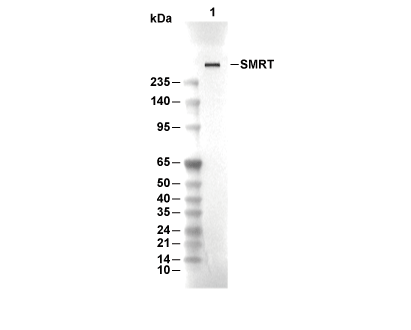 Lane 1: MOLT-4