
|
How to Cite 1. For In-Text Citation (Materials & Methods): 2. For Key Resources Table: |
||
|
Toll Free: (877) 796-6397 -- USA and Canada only -- |
Fax: +1-832-582-8590 Orders: +1-832-582-8158 |
Tech Support: +1-832-582-8158 Ext:3 Please provide your Order Number in the email. We strive to reply to |
Biological Description
| Specificity | SEC22B Antibody [P7F4] detects endogenous levels of total SEC22B protein. |
|---|---|
| Background | SEC22B, also known as vesicle‑trafficking protein SEC22b, is a member of the SNARE superfamily that localizes predominantly to the endoplasmic reticulum and ER–Golgi intermediate compartment, where it participates in constitutive secretory trafficking and specialized immune functions. The protein carries a characteristic SNARE motif that mediates pairing with cognate SNAREs, along with an N‑terminal region that contributes to targeting within the early secretory pathway and a C‑terminal transmembrane segment that anchors the protein in vesicular and pre‑Golgi membranes. SEC22B associates with ERGIC and Golgi‑derived vesicles and contributes to both anterograde and retrograde transport, regulating the flow of cargo between the ER, the ER–Golgi intermediate compartment, and the Golgi apparatus as part of the core machinery that maintains early secretory compartment organization and protein processing. Pairing of SEC22B with plasma membrane and endosomal SNAREs such as syntaxin 4 and related partners positions this protein at the interface between ER‑derived membranes and maturing phagosomes, supporting targeted delivery of ER or ERGIC components into phagosomal membranes. This SNARE‑dependent membrane fusion controls phagosome maturation kinetics, modulating the balance between acquisition of ER‑derived material, recruitment of lysosomal components, and the timing of degradative fusion steps. Antigen cross‑presentation in professional antigen‑presenting cells relies on SEC22B‑regulated fusion events that supply phagosomes with peptide loading machinery and ER‑associated components, allowing exogenous antigens to access the MHC class I presentation route and shaping the quality of CD8 T‑cell activation. SEC22B also participates in secretory autophagy and other unconventional trafficking routes, linking classical ER–Golgi transport with alternative secretion pathways that handle selected immune and stress‑related cargos important for intercellular communication and inflammatory responses. The positioning of SEC22B in the early secretory and phagosomal network connects this protein to signaling processes that depend on controlled surface expression of immune receptors, cytokines, and co‑stimulatory molecules, and to pathways that determine the proteolytic environment and peptide repertoire within antigen‑processing compartments. Altered SEC22B activity is associated with defects in vesicle fusion, disruption of ER–Golgi trafficking balance, and impaired antigen cross‑presentation, and sequence changes or expression abnormalities are reported in several human cancers, contributing to tumor‑related secretory remodeling and immune surveillance. |
Usage Information
| Application | WB, IP, IHC, IF | Dilution |
|
||||||||
|---|---|---|---|---|---|---|---|---|---|---|---|
| Reactivity | Mouse, Rat, Human | ||||||||||
| Source | Rabbit Monoclonal Antibody | MW | 25 kDa | ||||||||
| Storage Buffer | PBS, pH 7.2+50% Glycerol+0.05% BSA+0.01% NaN3 | Storage (from the date of receipt) |
-20°C (avoid freeze-thaw cycles), 2 years | ||||||||
References
|
Application Data
WB
Validated by Selleck
-
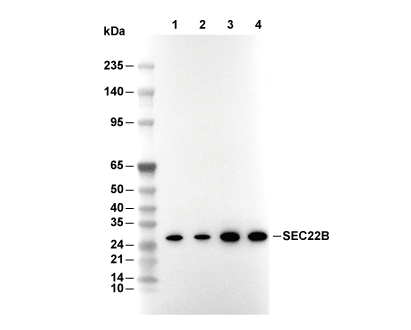 Lane 1: Hela, Lane 2: SH-SY5Y, Lane 3: Mouse spleen, Lane 4: Rat spleen