
|
How to Cite 1. For In-Text Citation (Materials & Methods): 2. For Key Resources Table: |
||
|
Toll Free: (877) 796-6397 -- USA and Canada only -- |
Fax: +1-832-582-8590 Orders: +1-832-582-8158 |
Tech Support: +1-832-582-8158 Ext:3 Please provide your Order Number in the email. We strive to reply to |
Biological Description
| Specificity | Rubella Virus capsid Antibody [M17H6] detects exogenous levels of total Rubella Virus capsid protein. |
|---|---|
| Background | Rubella virus capsid is the sole capsid protein of the rubella virus within the Rubivirus genus and functions as the core structural component that packages the positive-strand RNA genome and organizes virion assembly at intracellular membranes. The protein contains an N-terminal structural domain that forms the capsid protomer with a unique fold not observed in other viral capsids, and a more flexible C-terminal segment that carries basic and membrane-proximal elements important for RNA binding and interaction with the viral envelope glycoproteins. Capsid binds genomic RNA to form ribonucleoprotein cores and associates with the E1–E2 glycoprotein complex at Golgi-derived membranes, where coordinated interactions between its structural domain and the cytoplasmic tails of glycoproteins drive budding and generation of enveloped virions with defined core geometry. The three-dimensional arrangement of capsid protomers within the virion supports formation of an icosahedrally ordered core that stabilizes the RNA, positions it relative to the envelope, and contributes to overall particle integrity during extracellular transmission. Capsid also participates in virus–host communication by engaging host factors that influence translation and innate defense pathways, including interactions with cellular poly(A)-binding protein that modulate host translation and favor viral gene expression. Phosphorylation of defined residues in the capsid regulates RNA-binding capacity and nucleocapsid assembly, adding a layer of post-translational control that links the capsid–RNA interaction to the timing and efficiency of virion formation. During the rubella virus life cycle, the capsid functions together with nonstructural replicase components and envelope proteins to coordinate replication complex activity, nucleocapsid formation, and budding, embedding it at the interface between genome replication and particle morphogenesis. In infected tissues, the capsid contributes to persistence of viral RNA and maintenance of infectious virions, a property that is relevant to the teratogenic potential of the rubella virus and the pathogenesis of congenital rubella syndrome when infection occurs during early pregnancy. |
Usage Information
| Application | WB, ELISA | Dilution |
|
||
|---|---|---|---|---|---|
| Reactivity | Rubella virus | ||||
| Source | Mouse Monoclonal Antibody | MW | 115 kDa | ||
| Storage Buffer | PBS, pH 7.2+50% Glycerol+0.05% BSA+0.01% NaN3 | Storage (from the date of receipt) |
-20°C (avoid freeze-thaw cycles), 2 years | ||
References
|
Application Data
WB
Validated by Selleck
-
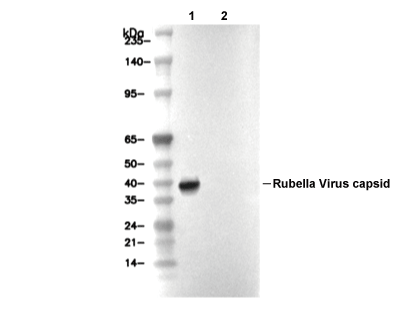 Lane 1: recombinant purified rubella capsid protein, Lane 2: irrelevant viral proteins