
|
How to Cite 1. For In-Text Citation (Materials & Methods): 2. For Key Resources Table: |
||
|
Toll Free: (877) 796-6397 -- USA and Canada only -- |
Fax: +1-832-582-8590 Orders: +1-832-582-8158 |
Tech Support: +1-832-582-8158 Ext:3 Please provide your Order Number in the email. We strive to reply to |
Biological Description
| Specificity | RSK4 Antibody [K23J12] detects endogenous levels of total RSK4 protein. |
|---|---|
| Background | RSK4, also designated RPS6KA6, belongs to the RSK family of serine/threonine protein kinases which comprises four vertebrate isoforms that function as downstream effectors of the Ras/ERK signaling pathway. RSK4 adopts the characteristic family architecture containing two functional kinase domains—an amino-terminal kinase domain responsible for substrate phosphorylation and a carboxyl-terminal kinase domain that regulates overall kinase activity through autophosphorylation—alongside a carboxy-terminal docking site that mediates interaction with ERK. RSK4 exhibits predominantly cytosolic localization and displays notably low basal expression levels compared to other RSK isoforms across diverse tissues including brain, kidney, and endothelial cells. The protein operates through atypical regulatory mechanisms that distinguish it from RSK1, RSK2, and RSK3, manifesting constitutive activation under serum-starved conditions where other RSK family members remain inactive owing to their dependence on growth factor stimulation. This constitutive activation arises from persistent phosphorylation at Ser232, Ser372, and Ser389, with basal ERK activity sufficient to induce approximately half of RSK4's maximum activity even without external mitogenic signals. RSK4 activation at Ser232 within the amino-terminal kinase domain activation loop proceeds independently of PDK1, contrasting with PDK1-dependent phosphorylation observed at equivalent sites in RSK1-3, highlighting divergent activation pathways. The protein participates in p53-dependent signaling cascades, contributing to cell growth arrest programs that operate independently of conventional growth factor-mediated proliferation signals. RSK4 functions as a regulator of transcription factor activity and protein synthesis through phosphorylation of downstream substrates including CREB, c-Fos, and ribosomal protein S6, thereby modulating gene expression programs controlling cell cycle progression, survival, and differentiation. The kinase engages with MAPK/ERK pathway components and intersects with PI3K/AKT signaling networks, positioning it at convergent nodes that integrate mitogenic and survival signals to coordinate cellular responses. RSK4 interacts with cell cycle regulatory proteins and modulates the activity of mTOR pathway components, influencing protein translation machinery and metabolic homeostasis. The protein exhibits context-dependent roles, functioning as a tumor suppressor through promotion of senescence and growth arrest while displaying oncogenic properties under specific cellular conditions that remain incompletely defined. RSK4 expression becomes downregulated across multiple human malignancies through mechanisms including promoter hypermethylation and transcriptional silencing, and loss of RSK4 function associates with enhanced invasiveness, metastatic potential, and therapeutic resistance in breast, ovarian, and renal cell carcinomas. Conversely, elevated RSK4 expression limits oncogenic transformation by restricting proliferative capacity and enforcing checkpoint control. |
Usage Information
| Application | WB, IHC, IF, FCM | Dilution |
|
||||||||
|---|---|---|---|---|---|---|---|---|---|---|---|
| Reactivity | Mouse, Rat, Human | ||||||||||
| Source | Rabbit Monoclonal Antibody | MW | 84 kDa | ||||||||
| Storage Buffer | PBS, pH 7.2+50% Glycerol+0.05% BSA+0.01% NaN3 | Storage (from the date of receipt) |
-20°C (avoid freeze-thaw cycles), 2 years | ||||||||
References
|
Application Data
WB
Validated by Selleck
-
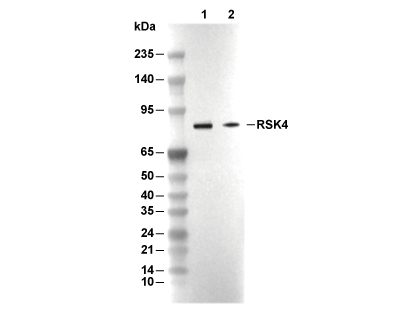 Lane 1: SH-SY5Y, Lane 2: Caco-2