
|
How to Cite 1. For In-Text Citation (Materials & Methods): 2. For Key Resources Table: |
||
|
Toll Free: (877) 796-6397 -- USA and Canada only -- |
Fax: +1-832-582-8590 Orders: +1-832-582-8158 |
Tech Support: +1-832-582-8158 Ext:3 Please provide your Order Number in the email. We strive to reply to |
Biological Description
| Specificity | RSK1 p90 Antibody [K1J12] detects endogenous levels of total RSK1 p90 protein. |
|---|---|
| Background | RSK1 (p90 ribosomal S6 kinase 1), a serine/threonine kinase of the RSK family positioned at the terminus of the Ras/Raf/MEK/ERK cascade, receives extracellular growth factor signals to drive proliferation, survival, and motility across diverse tissues, including brain, muscle, and epithelia. ERK1/2 docks at its C-terminal kinase domain to initiate sequential phosphorylation culminating in PDK1-mediated activation of the N-terminal catalytic site, enabling RSK1 to phosphorylate over 30 substrates spanning transcription factors, cytoskeletal regulators, and feedback inhibitors. Activated RSK1 docks at the nucleus to phosphorylate CREB at Ser133, inducing immediate early genes like c-Fos and Bcl-2 that promote G1/S transition and apoptosis resistance, while cytoplasmic RSK1 inhibits TSC2 to activate mTORC1/S6K1 for protein synthesis and phosphorylates Mkl1 to enhance SRF transcription of actin cytoskeletal genes driving lamellipodia formation. This dual nuclear-cytoplasmic action integrates immediate mitogenic responses with long-term adaptive gene programs, as RSK1 phosphorylates p27kip1 for cytoplasmic retention to unleash cyclin E-CDK2 while feedback phosphorylating Raf-1 at Ser259 to dampen upstream ERK flux. RSK1 sustains synaptic plasticity through CREB-dependent transcription in hippocampal neurons and coordinates muscle hypertrophy via mTORC1 during exercise, making it a precise readout for researchers dissecting ERK pathway fidelity in neuronal cultures or tumor organoids via phospho-S380 antibodies. Constitutive activation via upstream RAS/RAF mutations fuels prostate cancer progression by enhancing AR transcriptional activity through p300/CBP coactivator synergy and chemoresistance via YB-1 stabilization. |
Usage Information
| Application | WB, IP, IHC, IF, FCM | Dilution |
|
||||||||||
|---|---|---|---|---|---|---|---|---|---|---|---|---|---|
| Reactivity | Mouse, Rat, Human | ||||||||||||
| Source | Rabbit Monoclonal Antibody | MW | 83 kDa, 82 kDa | ||||||||||
| Storage Buffer | PBS, pH 7.2+50% Glycerol+0.05% BSA+0.01% NaN3 | Storage (from the date of receipt) |
-20°C (avoid freeze-thaw cycles), 2 years | ||||||||||
References
|
Application Data
WB
Validated by Selleck
-
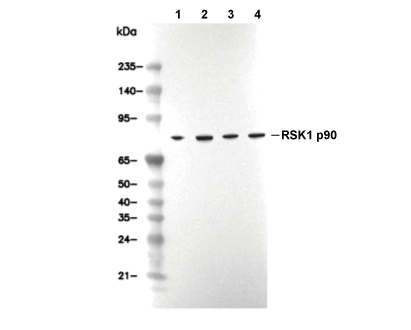 Lane 1: MCF7, Lane 2: K562, Lane 3: PC-12, Lane 4: Mouse lung