
|
How to Cite 1. For In-Text Citation (Materials & Methods): 2. For Key Resources Table: |
||
|
Toll Free: (877) 796-6397 -- USA and Canada only -- |
Fax: +1-832-582-8590 Orders: +1-832-582-8158 |
Tech Support: +1-832-582-8158 Ext:3 Please provide your Order Number in the email. We strive to reply to |
Biological Description
| Specificity | RPA70/RPA1 Antibody [N23A19] detects endogenous levels of total RPA70/RPA1 protein. |
|---|---|
| Background | RPA70, also designated RPA1, constitutes the largest subunit of the heterotrimeric replication protein A complex essential for eukaryotic DNA metabolism, coordinating replication, repair, and checkpoint activation through high-affinity single-stranded DNA binding. The protein incorporates three distinct DNA-binding domains connected by flexible linkers alongside protein interaction modules that enable oligomerization with RPA32 and RPA14 subunits to form a stable platform for recruiting replication and repair factors. During replication fork progression, RPA70 encases ssDNA generated at stalled forks, positioning DNA polymerase alpha-primase via direct binding to its p180 subunit while shielding nascent strands from nucleases and facilitating PCNA loading through coordinated trimerization interfaces. Upon double-strand breaks or UV-induced lesions, hyperphosphorylation by ATR and DNA-PK at multiple serine/threonine sites within the N-terminal domain induces conformational opening of the interdomain tether, enhancing affinity for the 9-1-1 checkpoint clamp and Rad17-RFC loader to amplify ATR-CHK1 signaling cascades that enforce S-phase arrest via Cdc25A degradation. This modification also redirects RPA70 toward homologous recombination by exposing BRCT motifs for BRCA1 and RAD51 paralog association, channeling ssDNA tails into presynaptic filament assembly. RPA70 stabilizes post-incision bubbles and coordinates XPA/Rad23B binding to verify damage-specific recognition before polymerase recruitment. The complex maintains basal nuclear localization with inducible foci formation at damage sites, where dephosphorylation by PP2A restores replication competence post-repair. Ubiquitous expression across proliferating tissues renders RPA70 indispensable for genome stability assays, with dominant-negative mutants disrupting replication licensing and hypersensitivity to genotoxins. |
Usage Information
| Application | WB | Dilution |
|
||
|---|---|---|---|---|---|
| Reactivity | Human, Mouse, Rat | ||||
| Source | Rabbit Monoclonal Antibody | MW | 70 kDa | ||
| Storage Buffer | PBS, pH 7.2+50% Glycerol+0.05% BSA+0.01% NaN3 | Storage (from the date of receipt) |
-20°C (avoid freeze-thaw cycles), 2 years | ||
References
|
Application Data
WB
Validated by Selleck
-
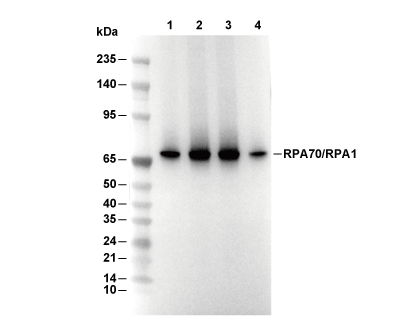 Lane 1: C2C12, Lane 2: Hela, Lane 3: C6, Lane 4: HUVEC