
|
How to Cite 1. For In-Text Citation (Materials & Methods): 2. For Key Resources Table: |
||
|
Toll Free: (877) 796-6397 -- USA and Canada only -- |
Fax: +1-832-582-8590 Orders: +1-832-582-8158 |
Tech Support: +1-832-582-8158 Ext:3 Please provide your Order Number in the email. We strive to reply to |
Biological Description
| Specificity | RGS2 Antibody [A1F17] detects endogenous levels of total RGS2 protein. |
|---|---|
| Background | RGS2 (regulator of G protein signaling 2) is a member of the B/R4 family of RGS proteins that controls signaling downstream of G protein–coupled receptors by accelerating GTP hydrolysis on heterotrimeric Gα subunits and limiting the duration and intensity of G protein–mediated responses in many tissues, including cardiovascular and nervous systems. The protein contains a central RGS domain that binds active Gα subunits and enhances their intrinsic GTPase activity, and an N‑terminal membrane-targeting region that anchors RGS2 near GPCR–G protein complexes at the plasma membrane, which positions the GAP function directly in the vicinity of receptor-activated Gαq/11 and Gαi/o proteins. RGS2 shows particularly strong GAP activity toward Gαq/11 and thereby suppresses phospholipase Cβ activation, diacylglycerol and inositol trisphosphate production, intracellular calcium elevation, and downstream activation of protein kinase C and MAPK pathways, whereas for Gαs it does not act as a GAP but directly inhibits selected adenylyl cyclase isoforms and reduces cAMP formation, so RGS2 provides negative control of both Gq- and Gs-linked signaling cascades at distinct molecular nodes. In vascular smooth muscle and the heart, RGS2 limits angiotensin II receptor– and other Gq/11-coupled receptor–mediated vasoconstrictor and hypertrophic signaling, restrains G protein–dependent activation of MAPKs, and contributes to normal vascular tone and cardiac growth control, while reduced RGS2 expression or function associates with enhanced vasoconstriction, elevated blood pressure, and susceptibility to hypertrophy, which places RGS2 as a key determinant of blood pressure homeostasis and cardiac remodeling. RGS2 expression is highly regulated at transcriptional and post-transcriptional levels and responds to GPCR activation, nitric oxide–cGMP–PKG signaling, and other pathways, creating feedback loops in which GPCR stimulation induces RGS2, and the induced protein then dampens further signaling from the same or related receptors. In neurons, RGS2 modulates Gq- and Gi/o-linked receptor pathways that influence synaptic plasticity, neuronal excitability, and anxiety-related behaviors, and also interacts with the translation factor eIF2Bε to inhibit guanine nucleotide exchange on eIF2B, providing an additional layer of translational control that connects GPCR activity to protein synthesis. Altered RGS2 expression or genetic variation associates with hypertension, heart failure, anxiety disorders, and certain cancers, and the combination of strong Gq-directed GAP activity, direct adenylyl cyclase inhibition, and translational regulation defines RGS2 as a multifunctional signaling hub for researchers exploring GPCR pharmacology, cardiovascular regulation, and neuropsychiatric or oncogenic signaling networks. |
Usage Information
| Application | WB, IP, IHC, IF, ELISA | Dilution |
|
||||||||
|---|---|---|---|---|---|---|---|---|---|---|---|
| Reactivity | Human, Mouse, Rat | ||||||||||
| Source | Mouse Monoclonal Antibody | MW | 24 kDa | ||||||||
| Storage Buffer | PBS, pH 7.2+50% Glycerol+0.05% BSA+0.01% NaN3 | Storage (from the date of receipt) |
-20°C (avoid freeze-thaw cycles), 2 years | ||||||||
References
|
Application Data
WB
Validated by Selleck
-
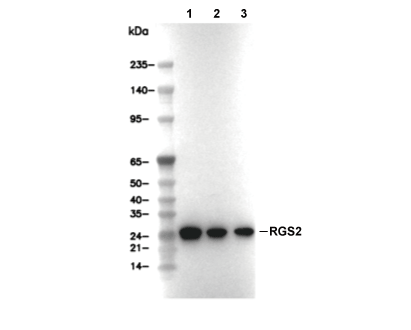 Lane 1: Hela, Lane 2: U-87 MG, Lane 3: MCF7