
|
How to Cite 1. For In-Text Citation (Materials & Methods): 2. For Key Resources Table: |
||
|
Toll Free: (877) 796-6397 -- USA and Canada only -- |
Fax: +1-832-582-8590 Orders: +1-832-582-8158 |
Tech Support: +1-832-582-8158 Ext:3 Please provide your Order Number in the email. We strive to reply to |
Biological Description
| Specificity | Proteasome 20S β7 Antibody [N12L11] detects endogenous levels of total Proteasome 20S β7 protein. |
|---|---|
| Background | Proteasome 20S β7 (PSMB7) is a proteasome B type subunit of the T1B family that forms one of the β subunits of the 20S core particle, a multicatalytic proteinase complex responsible for proteolytic degradation of most intracellular proteins in an ATP/ubiquitin dependent, non lysosomal pathway. The 20S core has a highly ordered ring shaped structure composed of four stacked rings, two outer α rings and two inner β rings, and PSMB7 is a 20S core β subunit that contributes to the threonine type endopeptidase activities located on β subunits facing the inner proteolytic chamber. Within this core, PSMB7 displays trypsin like activity and participates in the cleavage of peptide bonds in substrates that enter the chamber, including proteins involved in CDK mediated phosphorylation and removal of Cdc6 and in proteasome mediated degradation of activated PAK 2p34, linking this subunit to DNA replication licensing, cell cycle control, and signal transduction pathways that depend on regulated protein turnover. When the PSMB7 containing 20S core associates with two 19S regulatory particles, it forms the 26S proteasome, which performs ATP dependent degradation of polyubiquitinated substrates and maintains protein homeostasis by removing misfolded or damaged proteins and regulatory proteins whose activity must be terminated. The same 20S core can associate with PA200 or PA28 to form complexes that mediate ubiquitin independent proteolysis, with defined roles in spermatogenesis for 20S–PA200 and in generation of a subset of MHC class I–presented antigenic peptides for 20S–PA28, so PSMB7 contributes to reproductive function and antigen processing. Proteasomes containing PSMB7 are distributed throughout the cytoplasm and nucleus, providing proteolytic capacity in both compartments. Increased PSMB7 expression is observed in multiple myeloma, where higher levels distinguish advanced stages and are associated with shorter survival in bortezomib treated patients, and PSMB7 expression is higher in bortezomib than in thalidomide treated groups, establishing this subunit as a key gene in multiple myeloma development and resistance to bortezomib. |
Usage Information
| Application | WB, IP, IF, ELISA | Dilution |
|
||||||
|---|---|---|---|---|---|---|---|---|---|
| Reactivity | Human, Mouse, Rat | ||||||||
| Source | Mouse Monoclonal Antibody | MW | 30 kDa | ||||||
| Storage Buffer | PBS, pH 7.2+50% Glycerol+0.05% BSA+0.01% NaN3 | Storage (from the date of receipt) |
-20°C (avoid freeze-thaw cycles), 2 years | ||||||
References
|
Application Data
WB
Validated by Selleck
-
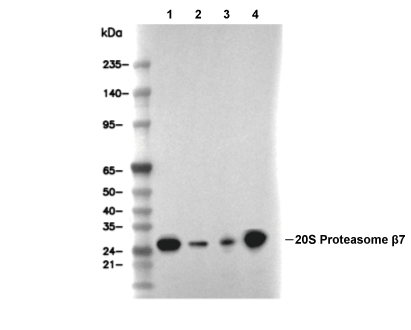 Lane 1: Hela, Lane 2: WI-38, Lane 3: F9, Lane 4: A-673