
|
How to Cite 1. For In-Text Citation (Materials & Methods): 2. For Key Resources Table: |
||
|
Toll Free: (877) 796-6397 -- USA and Canada only -- |
Fax: +1-832-582-8590 Orders: +1-832-582-8158 |
Tech Support: +1-832-582-8158 Ext:3 Please provide your Order Number in the email. We strive to reply to |
Biological Description
| Specificity | Phospho-Tuberin/TSC2 (Thr1462) Antibody [F15L14] detects endogenous levels of total Tuberin/TSC2 protein only when it is phosphorylated at Thr1462. |
|---|---|
| Background | Phospho‑Tuberin/TSC2 (Thr1462) represents a key regulated form of the TSC2 tumor suppressor, which functions with TSC1 in the tuberous sclerosis complex to restrain mTORC1‑dependent anabolic signaling and cell growth by acting as a GAP toward the small GTPase Rheb and thereby limiting phosphorylation of downstream effectors such as S6K1 and 4E‑BP1. Tuberin contains multiple regulatory domains and phosphorylation sites that integrate growth factor and stress signals, and Thr1462 lies within an Akt consensus motif in the C‑terminal region, where phosphorylation modulates the stability and activity of the TSC1–TSC2 complex and its ability to suppress mTORC1 signaling. Activation of the PI3K–Akt pathway by mitogenic and insulin signals leads to Akt‑dependent phosphorylation of Tuberin on Thr1462 together with Ser939, which reduces the tumor suppressor function of the TSC complex, permits increased Rheb‑GTP accumulation, and enhances mTORC1‑mediated phosphorylation of 4E‑BP1 and S6K1 that drives cap‑dependent translation, cell growth, and proliferation under nutrient‑replete conditions. Additional kinase pathways, including PKC/MAPK cascades and phosphatidic acid–linked signaling, converge on overlapping and distinct sites in Tuberin, so that Thr1462 phosphorylation participates in a broader phosphorylation code that integrates PI3K‑dependent and PI3K‑independent inputs to fine‑tune inhibition of mTORC1 and to coordinate responses to mitogens, phorbol esters, and other upstream cues. These regulatory events place phospho‑Tuberin (Thr1462) at a central nodal position connecting receptor tyrosine kinase and insulin signaling through PI3K–Akt to mTORC1‑driven biosynthesis and cell‑cycle progression, and make this site a sensitive indicator of growth factor signaling status, nutrient sufficiency, and pharmacologic Akt or mTORC1 inhibition. Tuberous sclerosis complex arises from germline or somatic loss‑of‑function alterations in TSC1 or TSC2, and aberrant control of Tuberin phosphorylation, including dysregulated modification at Thr1462, contributes to inappropriate activation of mTORC1 in hamartomas and tumor cells, supporting uncontrolled cell growth and altered protein synthesis; phosphorylation status at this site is therefore functionally linked to disease‑relevant signaling output and is widely used to monitor pathway engagement in basic research and in therapeutic contexts that target PI3K–Akt–mTOR axis components. |
Usage Information
| Application | WB, IHC | Dilution |
|
||||
|---|---|---|---|---|---|---|---|
| Reactivity | Mouse, Human | ||||||
| Source | Rabbit Monoclonal Antibody | MW | 201 kDa | ||||
| Storage Buffer | PBS, pH 7.2+50% Glycerol+0.05% BSA+0.01% NaN3 | Storage (from the date of receipt) |
-20°C (avoid freeze-thaw cycles), 2 years | ||||
References
|
Application Data
WB
Validated by Selleck
-
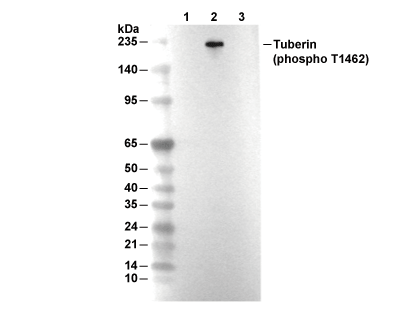 Lane 1: SH-SY5Y, Lane 2: SH-SY5Y (Okadaic Acid, 1uM, Calyculin A, 200nM, 60 min), Lane 3: SH-SY5Y (Okadaic Acid, 1uM, Calyculin A, 200nM, 60 min; phosphatase treated)