
|
How to Cite 1. For In-Text Citation (Materials & Methods): 2. For Key Resources Table: |
||
|
Toll Free: (877) 796-6397 -- USA and Canada only -- |
Fax: +1-832-582-8590 Orders: +1-832-582-8158 |
Tech Support: +1-832-582-8158 Ext:3 Please provide your Order Number in the email. We strive to reply to |
Biological Description
| Specificity | Phospho-Tau (Thr205) Antibody [J19P9] detects endogenous levels of total Tau protein only when it is phosphorylated at Thr205. |
|---|---|
| Background | Phospho-Tau at Thr205 represents a key post-translational modification on the microtubule-associated protein tau, one of six isoforms that differ in amino-terminal inserts and microtubule-binding repeat domains near the carboxy terminus, where this site resides within the second repeat region flanking the binding motifs. Tau normally binds and stabilizes axonal microtubules to support neuronal transport and structure, yet phosphorylation at Thr205 alongside nearby Ser199 and Ser202 alters protein conformation, exposing the proline-rich region proximal to the microtubule-binding domain and reducing affinity for tubulin polymers. This modification arises from kinase activities, including GSK-3, CDK5, and p38 MAPK, which target the site in response to stress or pathological signals, while protein phosphatase 2A selectively dephosphorylates Ser202/Thr205 in a microtubule polymerization-dependent manner. Phospho-Thr205 tau interacts more strongly with protein phosphatase 1 gamma (PP1γ) via its exposed domain, elevating active PP1γ levels and disrupting axonal transport in hippocampal neurons, as pseudophosphorylated mimics at these sites impair cargo movement and neurite outgrowth. The modification integrates into broader tauopathy pathways where hyperphosphorylation at AT8 epitopes (Ser199/Ser202/Thr205) precedes tangle formation by promoting paired helical filament assembly and neuropil threads. Elevated CSF levels of phospho-Thr205 tau correlate with white matter integrity loss in autosomal dominant Alzheimer's disease, independent of amyloid or vascular factors, and rise markedly in late Braak stages V/VI across cortical regions. In physiological settings, the site modulates tau's dynamic binding during neuronal development and stress responses, with dephosphorylation tied to intact microtubules, while dysregulation drives neurodegeneration in Alzheimer's and related tauopathies through microtubule destabilization and transport failure. |
Usage Information
| Application | WB, IP, IHC, IF | Dilution |
|
||||||||
|---|---|---|---|---|---|---|---|---|---|---|---|
| Reactivity | Human, Mouse, Rat | ||||||||||
| Source | Rabbit Monoclonal Antibody | MW | 50-80 kDa | ||||||||
| Storage Buffer | PBS, pH 7.2+50% Glycerol+0.05% BSA+0.01% NaN3 | Storage (from the date of receipt) |
-20°C (avoid freeze-thaw cycles), 2 years | ||||||||
References
|
Application Data
WB
Validated by Selleck
-
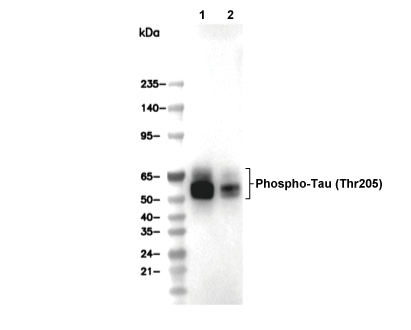 Lane 1: Mouse brain, Lane 2: Rat brain