
|
How to Cite 1. For In-Text Citation (Materials & Methods): 2. For Key Resources Table: |
||
|
Toll Free: (877) 796-6397 -- USA and Canada only -- |
Fax: +1-832-582-8590 Orders: +1-832-582-8158 |
Tech Support: +1-832-582-8158 Ext:3 Please provide your Order Number in the email. We strive to reply to |
Biological Description
| Specificity | Phospho-RPA32/RPA2 (Ser33) Antibody [H16F6] detects endogenous levels of total RPA32/RPA2 protein only when it is phosphorylated at Ser33. |
|---|---|
| Background | Phospho‑RPA32/RPA2 (Ser33) represents a checkpoint-activated form of the 32‑kDa subunit of the heterotrimeric replication protein A (RPA) complex, which binds and stabilizes single‑stranded DNA intermediates and coordinates DNA replication, recombination, and multiple DNA repair pathways through its interactions with DNA and a broad network of repair and checkpoint proteins. RPA is composed of RPA1 (70 kDa), RPA2 (RPA32), and RPA3 (14 kDa), with the major high‑affinity ssDNA‑binding activity residing in RPA1, while the N‑terminal region of RPA32 is rich in acidic residues and carries several serine and threonine phosphorylation sites, including Ser33, that function as regulatory elements controlling protein–protein interactions and dynamic redistribution on damaged chromatin. Ser33 lies within this N‑terminal regulatory domain and is a direct target of the PI3K‑like kinase ATR during replication stress and DNA damage, and its phosphorylation occurs early in the damage response, preceding or accompanying additional RPA32 phosphorylation events at Ser4, Ser8, and Thr21 that are catalyzed by ATR, ATM, and DNA‑PK and that together generate a hyperphosphorylated RPA32 species at stalled forks and DNA lesions. Phosphorylation at Ser33 promotes accumulation of RPA on damaged chromatin and formation of discrete nuclear foci, enhances recruitment of ATRIP and the ATR kinase through damage‑induced K63‑linked ubiquitination pathways centered on PRP19–CDC5L and RFWD3 E3 ligases, and facilitates subsequent assembly of RAD51 and other repair mediators at sites of replication stress, thereby coupling RPA‑coated ssDNA to ATR checkpoint activation and homologous recombination repair. The RPA complex with phosphorylated RPA32 at Ser33 maintains its core ssDNA‑binding function but displays altered affinity and interaction profiles with partners such as RAD51, RAD52, XPA, XPG, SMARCAL1, and mismatch repair proteins, and these changes tune pathway choice between fork stabilization, repriming, template switching, and recombination-mediated restart during the replication stress response. RPA32 phosphorylation is cell‑cycle regulated, with basal modifications at Ser23 and Ser29 by cyclin‑dependent kinases during S phase serving as priming events that permit subsequent Ser33 and N‑terminal hyperphosphorylation upon DNA damage, establishing a layered control system that links replication status to DNA damage signaling capacity. Ser33‑phosphorylated RPA32 participates in ATR‑dependent G2/M checkpoint control by supporting sustained ATR signaling, CHK1 activation, and maintenance of G2 arrest when double‑strand breaks or persistent replication intermediates are present, and perturbation of this phosphorylation axis compromises checkpoint robustness and genome stability. |
Usage Information
| Application | WB | Dilution |
|
||
|---|---|---|---|---|---|
| Reactivity | Human, Mouse, Rat | ||||
| Source | Rabbit Monoclonal Antibody | MW | 29 kDa | ||
| Storage Buffer | PBS, pH 7.2+50% Glycerol+0.05% BSA+0.01% NaN3 | Storage (from the date of receipt) |
-20°C (avoid freeze-thaw cycles), 2 years | ||
References
|
Application Data
WB
Validated by Selleck
-
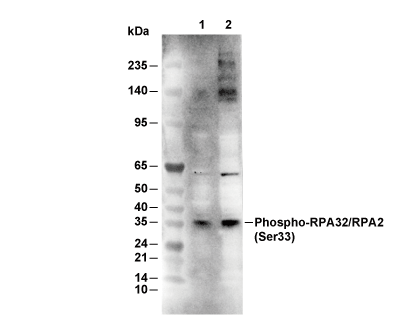 Lane 1: Hela, Lane 2: Hela (Camptothecin, 1 μM, 1 h)