
|
How to Cite 1. For In-Text Citation (Materials & Methods): 2. For Key Resources Table: |
||
|
Toll Free: (877) 796-6397 -- USA and Canada only -- |
Fax: +1-832-582-8590 Orders: +1-832-582-8158 |
Tech Support: +1-832-582-8158 Ext:3 Please provide your Order Number in the email. We strive to reply to |
Biological Description
| Specificity | Phospho-MST1/MST2 (T180 + T183) Antibody [B24N16] detects endogenous levels of total MST1 and MST2 protein only when it is phosphorylated at T180 and T183, respectively. |
|---|---|
| Background | Phospho-MST1/MST2 (T180/T183) denotes the critical activation loop phosphorylation on the sterile-20-like kinases MST1 (STK4) and MST2 (STK3), core components of the Hippo signaling pathway that enforce organ size control through coordinated regulation of proliferation and apoptosis. These kinases feature conserved N-terminal catalytic domains with the T-loop motif and C-terminal regulatory segments harboring nuclear export signals and SAV1 docking sites. Activation occurs via autophosphorylation at T180/T183 following caspase-3/7 cleavage during apoptosis, which liberates the kinase domain from auto-inhibition, or through canonical Hippo signaling where Tao kinases prime MST1/2 oligomerization and trans-phosphorylation, enabling complex formation with SAV1 to phosphorylate and activate LATS1/2 kinases. The MST1/2-SAV1-LATS1/2 cassette then targets YAP/TAZ coactivators for inhibitory Ser127 phosphorylation, promoting their cytoplasmic retention via 14-3-3 binding and β-TRCP-mediated degradation, thereby silencing TEAD-dependent transcription of growth-promoting genes like CTGF and CYR61. This cascade integrates diverse inputs, including cell density via Merlin and adherens junctions, energy status through AMPK crosstalk, and mechanical cues, positioning phospho-T180/T183 as a proximal readout of Hippo flux that restrains tissue overgrowth while licensing apoptosis in damaged cells. It governs epithelial morphogenesis, liver regeneration, and stem cell quiescence, making it indispensable for researchers modeling tissue homeostasis in organoids or dissecting mechanotransduction via phospho-specific biosensors. Dysregulation through hypo-phosphorylation unleashes YAP/TAZ oncogenic activity in cancers like mesothelioma and hepatocellular carcinoma. |
Usage Information
| Application | WB | Dilution |
|
||
|---|---|---|---|---|---|
| Reactivity | Human | ||||
| Source | Rabbit Monoclonal Antibody | MW | 56 kDa | ||
| Storage Buffer | PBS, pH 7.2+50% Glycerol+0.05% BSA+0.01% NaN3 | Storage (from the date of receipt) |
-20°C (avoid freeze-thaw cycles), 2 years | ||
References
|
Application Data
WB
Validated by Selleck
-
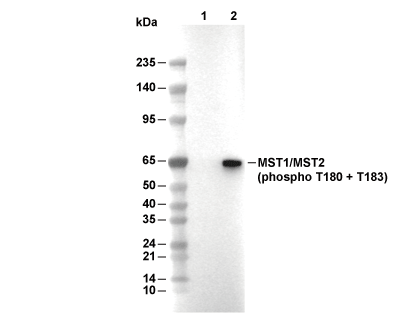 Lane 1: Hela, Lane 2: Hela (Calyculin A treated)