
|
How to Cite 1. For In-Text Citation (Materials & Methods): 2. For Key Resources Table: |
||
|
Toll Free: (877) 796-6397 -- USA and Canada only -- |
Fax: +1-832-582-8590 Orders: +1-832-582-8158 |
Tech Support: +1-832-582-8158 Ext:3 Please provide your Order Number in the email. We strive to reply to |
Biological Description
| Specificity | Phospho-Lck (Tyr505) Antibody [P3K14] detects endogenous levels of total Lck protein only when it is phosphorylated at Tyr505. |
|---|---|
| Background | Phospho-Lck at Tyr505 represents the inactive form of Lck, a Src family tyrosine kinase essential for initiating T cell receptor signaling in T lymphocytes. Lck possesses N-terminal myristoylation and palmitoylation sites that anchor it to the plasma membrane and Golgi apparatus, SH3 and SH2 domains for protein interactions, and a kinase domain flanked by regulatory tyrosines Tyr394 and Tyr505 in the activation loop and C-terminal tail, respectively. Phosphorylation at Tyr505 by C-terminal Src kinase (Csk) induces intramolecular binding of the phosphotyrosine tail to the SH2 domain, clamping the kinase into a closed conformation that inhibits catalytic activity and substrate access, maintaining Lck in a primed but inactive state in resting T cells. Dephosphorylation of Tyr505 by CD45 phosphatase exposes the activation loop, permitting trans-autophosphorylation at Tyr394 that stabilizes an open conformation and enhances kinase activity toward immunoreceptor tyrosine-based activation motifs (ITAMs) on CD3ζ chains upon TCR engagement. Activated Lck then recruits and phosphorylates Zap-70 via its tandem SH2 domains on phospho-ITAMs, propagating signals through LAT adaptor phosphorylation to assemble multimolecular complexes that activate phospholipase Cγ1, calcium fluxes, ERK, NF-κB, and NFAT pathways, driving cytokine production, proliferation, and differentiation. Tyr505 phosphorylation predominates in unstimulated states, with TCR stimulation triggering localized dephosphorylation and Tyr394 phosphorylation primarily at the plasma membrane near engaged TCR clusters, where about 20% of Lck molecules undergo conformational opening. |
Usage Information
| Application | WB | Dilution |
|
||
|---|---|---|---|---|---|
| Reactivity | Human, Mouse, Rat | ||||
| Source | Rabbit Monoclonal Antibody | MW | 56 kDa | ||
| Storage Buffer | PBS, pH 7.2+50% Glycerol+0.05% BSA+0.01% NaN3 | Storage (from the date of receipt) |
-20°C (avoid freeze-thaw cycles), 2 years | ||
References
|
Application Data
WB
Validated by Selleck
-
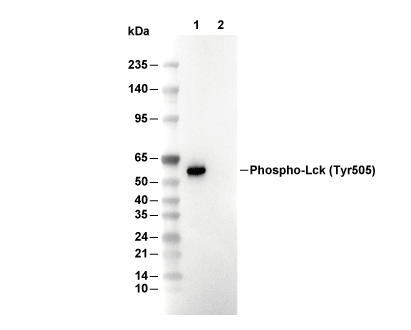 Lane 1: Jurkat, Lane 2: Jurkat (phosphatase treated)