
|
How to Cite 1. For In-Text Citation (Materials & Methods): 2. For Key Resources Table: |
||
|
Toll Free: (877) 796-6397 -- USA and Canada only -- |
Fax: +1-832-582-8590 Orders: +1-832-582-8158 |
Tech Support: +1-832-582-8158 Ext:3 Please provide your Order Number in the email. We strive to reply to |
Biological Description
| Specificity | Phospho-JunB (Thr102/Thr104) Antibody [A14M16] detects endogenous levels of total JunB protein only when it is phosphorylated at Thr102/Thr104. |
|---|---|
| Background | Phospho‑JunB (Thr102/Thr104) represents an activated, signal-integrating form of the JunB transcription factor within the AP‑1 family, which includes c‑Jun and JunD and operates as dimeric complexes with other bZIP partners such as Fos and ATF proteins to control gene programs induced by growth factors, immune mediators, and stress-regulated kinase cascades. JunB contains an N‑terminal transactivation region that carries the JNK-responsive Thr102 and Thr104 residues, a central basic DNA‑binding region that recognizes AP‑1 consensus elements, and a C‑terminal leucine zipper domain that mediates dimerization, and this modular organization allows phosphorylation at Thr102/Thr104 to modulate both DNA binding and cooperative interactions with partner proteins on target promoters. During T helper cell differentiation, JunB expression increases selectively in Th2-lineage cells, where JunB binds the P1 regulatory element within the IL‑4 promoter and forms heterodimers with c‑Maf; phosphorylation of Thr102 and Thr104 by JNK mitogen‑activated protein kinases enhances binding of this JunB/c‑Maf complex to the P1 site and increases transcriptional activation of IL‑4, which supports Th2-restricted expression of this cytokine. This phosphorylation-dependent gain of function places phospho‑JunB (Thr102/Thr104) as a key node that links upstream JNK signaling, triggered by T cell receptor engagement and costimulatory inputs, to selective IL‑4 promoter occupancy and to the broader Th2 cytokine profile that includes coordinated induction of other Th2-associated genes. JunB with phosphorylated Thr102/Thr104 contributes to AP‑1 activity in hematopoietic contexts beyond Th2 cells, integrating mitogen-activated kinase signals to regulate genes involved in proliferation control, senescence, and differentiation, and it participates in transcriptional networks that influence hematopoietic stem cell pool size and lineage allocation. JunB activity at these sites interacts with other lineage-specifying factors and chromatin regulators to shape cell-cycle progression and exit, assigning JunB and its phosphorylated forms roles as modulators of proliferation and differentiation balance in myeloid and lymphoid compartments. Altered JunB regulation, including dysregulated expression or aberrant AP‑1 signaling, is associated with chronic myelogenous leukemia and acute myeloid leukemia, where changes in JunB function influence leukemic cell proliferation and maturation states, and phospho‑JunB (Thr102/Thr104) serves as a readout of JNK‑AP‑1 pathway activity that can be monitored using phosphorylation-specific antibodies. |
Usage Information
| Application | WB, IP | Dilution |
|
||||
|---|---|---|---|---|---|---|---|
| Reactivity | Human | ||||||
| Source | Rabbit Monoclonal Antibody | MW | 36 kDa | ||||
| Storage Buffer | PBS, pH 7.2+50% Glycerol+0.05% BSA+0.01% NaN3 | Storage (from the date of receipt) |
-20°C (avoid freeze-thaw cycles), 2 years | ||||
References
|
Application Data
WB
Validated by Selleck
-
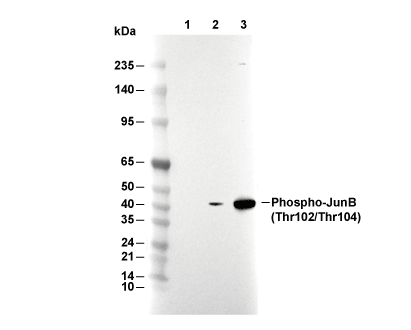 Lane 1: 293T, Lane 2: 293T (Anisomycin, 25 ug/ml, 15 min), Lane 3: 293T (Anisomycin, 25 ug/ml, 30 min)