
|
How to Cite 1. For In-Text Citation (Materials & Methods): 2. For Key Resources Table: |
||
|
Toll Free: (877) 796-6397 -- USA and Canada only -- |
Fax: +1-832-582-8590 Orders: +1-832-582-8158 |
Tech Support: +1-832-582-8158 Ext:3 Please provide your Order Number in the email. We strive to reply to |
Biological Description
| Specificity | Phospho-CAD (Ser1859) Antibody [C23K19] detects endogenous levels of total CAD protein only when it is phosphorylated at Ser1859. |
|---|---|
| Background | Phospho-CAD (Ser1859) functions as the activated form of the multifunctional CAD enzyme complex that catalyzes the initial three steps of de novo pyrimidine biosynthesis, converting glutamine to carbamoyl phosphate, then to carbamoyl aspartate, and finally to dihydroorotate en route to UMP production essential for RNA and DNA synthesis. CAD assembles as a hexameric structure with distinct catalytic domains for glutamine amidotransferase (GLNase), carbamoyl-phosphate synthetase (CPSase), aspartate transcarbamoylase (ATCase), and dihydroorotase (DHOase), where phosphorylation at Ser1859 within the CPSase domain stabilizes inter-subunit contacts to enhance enzymatic flux through allosteric relief of feedback inhibition by UTP. mTORC1 pathway activation transmits growth signals through S6K1 kinase to deposit this phosphate mark, promoting CAD oligomerization that accelerates glutamine-dependent CPSase activity and ATCase condensation while coordinating with pentose phosphate pathway flux to match nucleotide demand during S-phase progression. ERK1/2 phosphorylation at Thr456 drives nuclear translocation upon G1/S entry, positioning phospho-CAD to support replication fork progression and chromatin remodeling, with subsequent PKA-mediated Ser1406 phosphorylation facilitating cytoplasmic return as cells exit S phase. This dynamic phospho-regulation integrates nutrient sensing via amino acids and growth factors with cell cycle checkpoints, ensuring pyrimidine pools align with proliferative states in rapidly dividing tissues like embryonic epithelia and hematopoietic progenitors. Dysregulation manifests as elevated Ser1859 phosphorylation in prostate adenocarcinoma and castration-resistant subtypes, correlating with mTOR hyperactivation and biochemical relapse through unrestrained nucleotide synthesis fueling genomic instability. |
Usage Information
| Application | WB, IHC | Dilution |
|
||||
|---|---|---|---|---|---|---|---|
| Reactivity | Human, Mouse, Rat | ||||||
| Source | Rabbit Monoclonal Antibody | MW | 240 kDa | ||||
| Storage Buffer | PBS, pH 7.2+50% Glycerol+0.05% BSA+0.01% NaN3 | Storage (from the date of receipt) |
-20°C (avoid freeze-thaw cycles), 2 years | ||||
References
|
Application Data
WB
Validated by Selleck
-
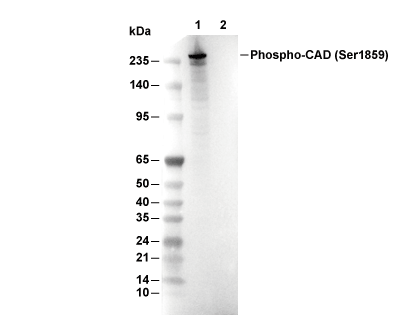 Lane 1: 293T, Lane 2: 293T (λ phosphatase treated)