
|
How to Cite 1. For In-Text Citation (Materials & Methods): 2. For Key Resources Table: |
||
|
Toll Free: (877) 796-6397 -- USA and Canada only -- |
Fax: +1-832-582-8590 Orders: +1-832-582-8158 |
Tech Support: +1-832-582-8158 Ext:3 Please provide your Order Number in the email. We strive to reply to |
Biological Description
| Specificity | Phospho-ATM (Ser1981) Antibody [A4J11] detects endogenous levels of total ATM protein only when it is phosphorylated at Ser1981. |
|---|---|
| Background | Phospho ATM at Ser1981 (ATM S1981ph) is the canonical activation mark of the ataxia telangiectasia mutated (ATM) kinase, a central phosphoinositide 3 kinase related kinase that orchestrates the cellular response to DNA double strand breaks in the PIKK signaling network. In the absence of damage, inactive ATM is predominantly dimeric and held in a closed conformation, but when double strand breaks occur the MRE11–RAD50–NBS1 (MRN) sensor complex recruits ATM to the lesion and promotes acetylation dependent dissociation of the dimer, enabling autophosphorylation at Ser1981 in trans, which stabilizes the active monomeric form and reinforces its retention at the break site through interaction with mediators such as MDC1. Once phosphorylated at Ser1981, ATM propagates a robust signaling cascade by phosphorylating numerous downstream effectors, including histone H2AX at Ser139, CHK2, p53, BRCA1, and DNA repair checkpoint associated proteins, thereby coupling DSB detection to cell cycle arrest, DNA repair, and, when damage is severe, senescence or apoptosis. These ATM S1981ph dependent signals integrate with parallel ATR and DNA PKcs pathways to coordinate G2/M checkpoint enforcement, homologous recombination, non homologous end joining, and transcriptional responses across multiple cell types, making phospho ATM Ser1981 a widely used readout for genotoxic stress and DNA damage signaling in experimental systems. In ataxia telangiectasia, loss of ATM function abolishes Ser1981 phosphorylation and disrupts DSB induced checkpoint activation, leading to extreme radiosensitivity, neurodegeneration, and increased cancer risk, so that ATM S1981ph dependent signaling is ultimately dysregulated in both hereditary DNA repair deficiency and various cancer prone contexts. |
Usage Information
| Application | WB | Dilution |
|
||
|---|---|---|---|---|---|
| Reactivity | Human | ||||
| Source | Rabbit Monoclonal Antibody | MW | 350 kDa | ||
| Storage Buffer | PBS, pH 7.2+50% Glycerol+0.05% BSA+0.01% NaN3 | Storage (from the date of receipt) |
-20°C (avoid freeze-thaw cycles), 2 years | ||
References
|
Application Data
WB
Validated by Selleck
-
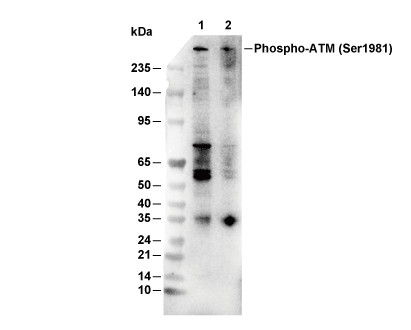 Lane 1: 293 (UV, 4 h), Lane 2: 293