
|
How to Cite 1. For In-Text Citation (Materials & Methods): 2. For Key Resources Table: |
||
|
Toll Free: (877) 796-6397 -- USA and Canada only -- |
Fax: +1-832-582-8590 Orders: +1-832-582-8158 |
Tech Support: +1-832-582-8158 Ext:3 Please provide your Order Number in the email. We strive to reply to |
Biological Description
| Specificity | Phospho-Atg14 (Ser29) Antibody [B12C19] detects endogenous levels of total Atg14 protein only when it is phosphorylated at Ser29. |
|---|---|
| Background | Phospho-Atg14 (Ser29) designates a key regulatory phosphorylation on Atg14L, a core subunit of the PI3KC3 (Vps34) complex pivotal to autophagy initiation, where it associates with Beclin-1, Vps34, and Vps15 to generate PI3P at nascent phagophores, driving membrane curvature and LC3 lipidation for autophagosome biogenesis. Atg14L features a coiled-coil domain for Beclin-1 heterodimerization and a BATS domain that anchors the complex to ER subdomains and isolation membranes, positioning Ser29 within an N-terminal regulatory motif sensitive to kinase modulation. TBK1 phosphorylates Ser29 in response to nutrient stress or pathogen sensing, enhancing Atg14L recruitment to omegasomes and boosting Vps34 lipid kinase activity through allosteric conformational shifts that promote PI3P production and Atg9 trafficking for phagophore expansion. This modification integrates into the ULK1-TBK1-Beclin-1 signaling axis, where Ser29 phosphorylation synergizes with ULK1-mediated Beclin-1 activation to amplify autophagy flux under starvation, while counteracting mTORC1 suppression ensures rapid autophagosome formation for selective cargo engulfment like damaged mitochondria. Phospho-Ser29 drives dynamic membrane remodeling in diverse cellular contexts, from neuronal survival during ER stress to immune cell activation against intracellular pathogens, making it invaluable for researchers tracking autophagy kinetics via phospho-specific probes or dissecting TBK1 dependency in high-throughput screens. Dysregulation through hypo-phosphorylation impairs autophagic clearance, contributing to neurodegeneration and tumorigenesis, whereas hyperactivation risks excessive catabolism in metabolic disorders. |
Usage Information
| Application | WB, IF, FCM | Dilution |
|
||||||
|---|---|---|---|---|---|---|---|---|---|
| Reactivity | Human, Mouse, Rat | ||||||||
| Source | Rabbit Monoclonal Antibody | MW | 65 kDa | ||||||
| Storage Buffer | PBS, pH 7.2+50% Glycerol+0.05% BSA+0.01% NaN3 | Storage (from the date of receipt) |
-20°C (avoid freeze-thaw cycles), 2 years | ||||||
References
|
Application Data
WB
Validated by Selleck
-
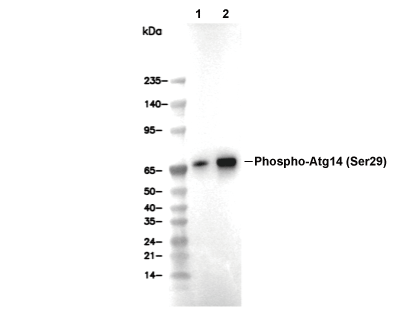 Lane 1: Saos-2, Lane 2: Saos-2 (EBSS, 2 h)