
|
How to Cite 1. For In-Text Citation (Materials & Methods): 2. For Key Resources Table: |
||
|
Toll Free: (877) 796-6397 -- USA and Canada only -- |
Fax: +1-832-582-8590 Orders: +1-832-582-8158 |
Tech Support: +1-832-582-8158 Ext:3 Please provide your Order Number in the email. We strive to reply to |
Biological Description
| Specificity | PHD3 Antibody [H19K23] detects endogenous levels of total PHD3 protein. |
|---|---|
| Background | Prolyl hydroxylase domain‑containing protein 3 (PHD3; EGLN3) is an Fe²⁺‑ and 2‑oxoglutarate‑dependent dioxygenase that functions as a cellular oxygen sensor by hydroxylating proline residues on hypoxia‑inducible transcription factors HIF‑1α and HIF‑2α and thereby targeting them for von Hippel–Lindau–mediated ubiquitination and proteasomal degradation under normoxic conditions. PHD3 is widely expressed in oxygen‑sensitive tissues such as the heart, brain, and skeletal muscle, and its transcription is induced by both HIF‑1α and HIF‑2α, creating a feedback loop that couples oxygen availability to the stability and activity of HIF‑dependent transcription programs. Under hypoxia, reduced PHD3 activity allows HIF‑1α and HIF‑2α to accumulate, bind hypoxia‑responsive elements, and drive the expression of genes involved in erythropoiesis, angiogenesis, and metabolic adaptation, whereas PHD3‑dependent hydroxylation restrains this program when oxygen returns. PHD3 can act as a nuclear cofactor for HIF‑1α, enhancing HIF‑1α‑driven transcription at specific target promoters, and PHD3 expression modulates EGFR phosphorylation and downstream mitogenic signaling in certain tumor types. Loss or downregulation of PHD3 enables tumor cells to grow in hypoxic microenvironments by stabilizing HIF‑dependent pathways and by providing an alternative route of EGFR activation, promoting tumor expansion and resistance to hypoxia‑associated stress. Depletion of PHD3 reduces cardiomyocyte apoptosis and infarct size after ischemia–reperfusion, and loss of PHD3 in myeloid cells dampens inflammatory activation in injured skeletal muscle. |
Usage Information
| Application | WB, IP, IF | Dilution |
|
||||||
|---|---|---|---|---|---|---|---|---|---|
| Reactivity | Mouse, Rat, Human | ||||||||
| Source | Rabbit Monoclonal Antibody | MW | 27 kDa | ||||||
| Storage Buffer | PBS, pH 7.2+50% Glycerol+0.05% BSA+0.01% NaN3 | Storage (from the date of receipt) |
-20°C (avoid freeze-thaw cycles), 2 years | ||||||
References
|
Application Data
WB
Validated by Selleck
-
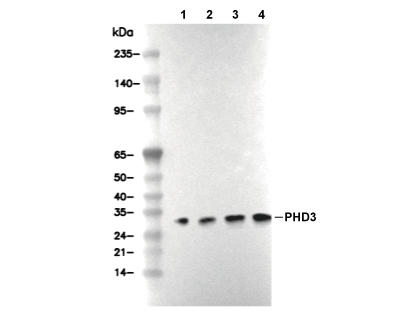 Lane 1: RAW 264.7, Lane 2: PC-12, Lane 3: Mouse brain, Lane 4: Rat brain