
|
How to Cite 1. For In-Text Citation (Materials & Methods): 2. For Key Resources Table: |
||
|
Toll Free: (877) 796-6397 -- USA and Canada only -- |
Fax: +1-832-582-8590 Orders: +1-832-582-8158 |
Tech Support: +1-832-582-8158 Ext:3 Please provide your Order Number in the email. We strive to reply to |
Biological Description
| Specificity | PELP1 Antibody [M14C23] detects endogenous levels of total PELP1 protein. |
|---|---|
| Background | Proline‑, glutamic acid‑, and leucine‑rich protein 1 (PELP1), also termed MNAR, is a large multidomain scaffolding protein that functions as a transcriptional coregulator for multiple nuclear receptors and transcription factors and also serves as a cytoplasmic signaling adaptor linking steroid hormone receptors to kinase pathways. The protein contains numerous LXXLL nuclear receptor–interaction motifs, a histone‑binding region that recognizes specific histone tails and their modifications, and low‑complexity segments that support assembly into large chromatin and ribonucleoprotein complexes, allowing PELP1 to bridge steroid receptors, chromatin modifiers, and transcriptional machinery. Interaction with estrogen receptor alpha positions PELP1 as a coactivator that enhances estrogen‑dependent transcription by recruiting histone acetyltransferases and other chromatin‑remodeling activities to ER‑regulated promoters, while parallel interactions with glucocorticoid, progesterone, androgen, and orphan nuclear receptors place it as a broader coregulator that can act as either coactivator or corepressor depending on receptor and promoter context. In the cytoplasm, PELP1 associates with ER and growth factor receptors together with Src and PI3K, forming signaling modules that couple estrogen or growth factor stimulation to rapid activation of MAPK/ERK and PI3K/AKT pathways and thereby integrate hormonal cues with cell‑cycle entry, survival, and cytoskeletal reorganization. PELP1 acts as a core component of the 5FMC and related nucleolar complexes that participate in late steps of 28S rRNA processing and maturation of the 60S ribosomal subunit, regulating recruitment of the remodeling factor MDN1 and thereby influencing ribosome biogenesis and global translational capacity. Interactions with p53 place PELP1 as a p53 coactivator that modulates expression of p53 target genes during genotoxic stress, linking it to DNA damage response networks and apoptosis regulation. Expression of PELP1 is elevated in several hormone‑driven malignancies, including breast and prostate cancers, where its nuclear and cytoplasmic signaling functions correlate with enhanced proliferation, migration, and metastatic behavior, and with decreased sensitivity to endocrine therapies through promotion of ER/growth factor cross‑talk and activation of kinase pathways that support hormone‑independent receptor signaling. |
Usage Information
| Application | WB, IHC, IF, FCM | Dilution |
|
||||||||
|---|---|---|---|---|---|---|---|---|---|---|---|
| Reactivity | Human | ||||||||||
| Source | Rabbit Monoclonal Antibody | MW | 120 kDa | ||||||||
| Storage Buffer | PBS, pH 7.2+50% Glycerol+0.05% BSA+0.01% NaN3 | Storage (from the date of receipt) |
-20°C (avoid freeze-thaw cycles), 2 years | ||||||||
References
|
Application Data
WB
Validated by Selleck
-
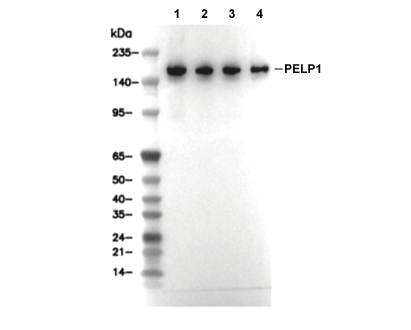 Lane 1: 293T, Lane 2: T-47D, Lane 3: MCF7, Lane 4: Hela