
|
How to Cite 1. For In-Text Citation (Materials & Methods): 2. For Key Resources Table: |
||
|
Toll Free: (877) 796-6397 -- USA and Canada only -- |
Fax: +1-832-582-8590 Orders: +1-832-582-8158 |
Tech Support: +1-832-582-8158 Ext:3 Please provide your Order Number in the email. We strive to reply to |
Technical Data
| Formula | C11H9NO5S |
||||||||||
| Molecular Weight | 267.26 | CAS No. | 343351-67-7 | ||||||||
| Solubility (25°C)* | In vitro | DMSO | 53 mg/mL (198.3 mM) | ||||||||
| Water | Insoluble | ||||||||||
| Ethanol | Insoluble | ||||||||||
| In vivo (Add solvents to the product individually and in order) |
|
||||||||||
|
* <1 mg/ml means slightly soluble or insoluble. * Please note that Selleck tests the solubility of all compounds in-house, and the actual solubility may differ slightly from published values. This is normal and is due to slight batch-to-batch variations. * Room temperature shipping (Stability testing shows this product can be shipped without any cooling measures.) |
|||||||||||
Preparing Stock Solutions
Biological Activity
| Description | NSC697923 is a cell-permeable and selective inhibitor of the Ub-conjugating enzyme (E2) complex Ubc13-Uev1A. | |
|---|---|---|
| Targets |
|
|
| In vitro | NSC697923 selectively inhibits PMA-induced NF-κB activation, and also inhibits IκBα phosphorylation by both RANKL and LPS. This compound impedes the formation of the Ubc13 and ubiquitin thioester conjugate and suppresses constitutive NF-κB activity in ABC-DLBCL cells. In addition, it inhibits the proliferation and survival of ABC-DLBCL cells and GCB-DLBCL cells, and also induces apoptosis of primary DLBCL cells. In neuroblastoma (NB) cell lines, this chemical shows cytotoxic effect, and inhibits both anchorage-dependent and -independent colony formation. | |
| In vivo | NSC697923 (5 mg/kg/day, i.p.) demonstrates potent antitumor efficacy in both NB SH-SY5Y and NGP xenografts. |
Protocol (from reference)
| Kinase Assay:[1] |
|
|---|---|
| Cell Assay:[1] |
|
| Animal Study:[2] |
|
References
|
Customer Product Validation
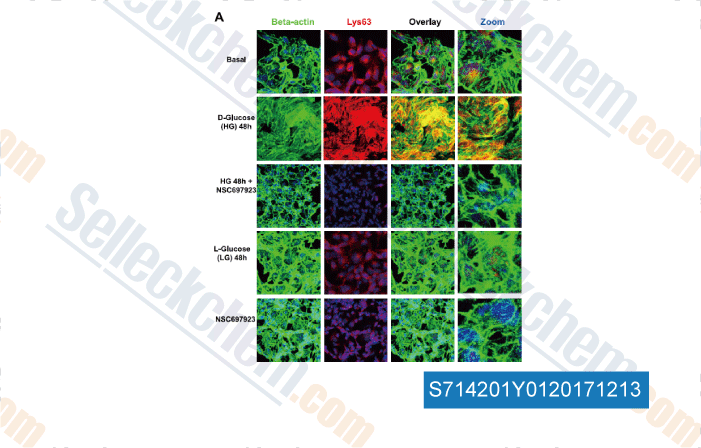
-
Data from [ , , FASEB J, 2017, 31(1):308-319 ]
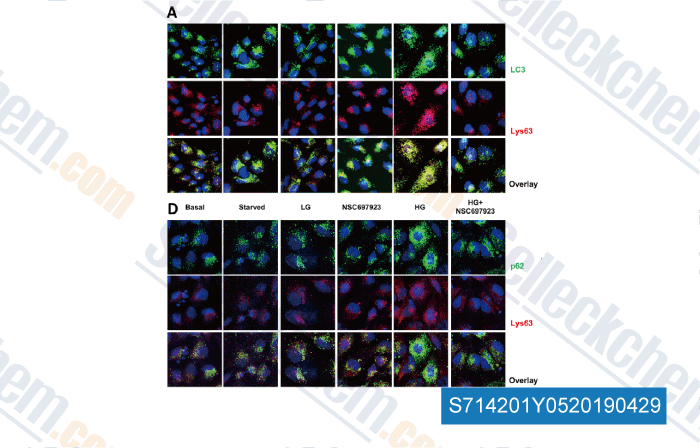
-
Data from [ , , J Mol Med (Berl), 2018, 96(7):645-659 ]
Selleck's NSC697923 Has Been Cited by 25 Publications
| Evaluating biological activity of compounds by transcription factor activity profiling [ Science Advances, September 26, 2018, eaar4666] | PubMed: 30263952 |
| Ubiquitination status does not affect Vps34 degradation [ Genes & Diseases, September 2020, 401-407] | PubMed: 37503842 |
| CRISPR-Cas9 knockout screen identifies novel treatment targets in childhood high-grade glioma [ Clinical Epigenetics, May 9, 2023, 80] | PubMed: 37161535 |
| Ube2v1-mediated ubiquitination and degradation of Sirt1 promotes metastasis of colorectal cancer by epigenetically suppressing autophagy [ Journal of Hematology & Oncology, July 17, 2018, 95] | PubMed: 30016968 |
| Covalent inhibition of Plasmodium falciparum Ubc13 impairs global protein synthesis [ iScience, April 28, 2025, 112545] | PubMed: 40491475 |
| TLR4 endocytosis and endosomal TLR4 signaling are distinct and independent outcomes of TLR4 activation [ EMBO Rep, 2025, 10.1038/s44319-025-00444-2] | PubMed: 40204912 |
| TLR4 endocytosis and endosomal TLR4 signaling are distinct and independent outcomes of TLR4 activation [ EMBO Reports, 2025, 2740–2766] | PubMed: 40204912 |
| Covalent inhibition of Plasmodium falciparum Ubc13 impairs global protein synthesis [ iScience, 2025, 112545] | PubMed: 40491475 |
| Polyubiquitinated PCNA triggers SLX4-mediated break-induced replication in alternative lengthening of telomeres (ALT) cancer cells [ Nucleic Acids Research, 2024, gkae785] | PubMed: 39291733 |
| Polyubiquitinated PCNA triggers SLX4-mediated break-induced replication in alternative lengthening of telomeres (ALT) cancer cells [ Nucleic Acids Res, 2024, gkae785] | PubMed: 39291733 |
RETURN POLICY
Selleck Chemical’s Unconditional Return Policy ensures a smooth online shopping experience for our customers. If you are in any way unsatisfied with your purchase, you may return any item(s) within 7 days of receiving it. In the event of product quality issues, either protocol related or product related problems, you may return any item(s) within 365 days from the original purchase date. Please follow the instructions below when returning products.
SHIPPING AND STORAGE
Selleck products are transported at room temperature. If you receive the product at room temperature, please rest assured, the Selleck Quality Inspection Department has conducted experiments to verify that the normal temperature placement of one month will not affect the biological activity of powder products. After collecting, please store the product according to the requirements described in the datasheet. Most Selleck products are stable under the recommended conditions.
NOT FOR HUMAN, VETERINARY DIAGNOSTIC OR THERAPEUTIC USE.