
|
How to Cite 1. For In-Text Citation (Materials & Methods): 2. For Key Resources Table: |
||
|
Toll Free: (877) 796-6397 -- USA and Canada only -- |
Fax: +1-832-582-8590 Orders: +1-832-582-8158 |
Tech Support: +1-832-582-8158 Ext:3 Please provide your Order Number in the email. We strive to reply to |
Technical Data
| Formula | C14H11N |
||||||
| Molecular Weight | 193.24 | CAS No. | 96206-92-7 | ||||
| Solubility (25°C)* | In vitro | DMSO | 39 mg/mL (201.82 mM) | ||||
| Ethanol | 39 mg/mL (201.82 mM) | ||||||
| Water | Insoluble | ||||||
| In vivo (Add solvents to the product individually and in order) |
|
||||||
|
* <1 mg/ml means slightly soluble or insoluble. * Please note that Selleck tests the solubility of all compounds in-house, and the actual solubility may differ slightly from published values. This is normal and is due to slight batch-to-batch variations. * Room temperature shipping (Stability testing shows this product can be shipped without any cooling measures.) |
|||||||
Preparing Stock Solutions
Biological Activity
| Description | MPEP is a selective mGlu5 receptor antagonist with IC50 of 36 nM, and this compound exhibits no appreciable activity at mGlu1b/2/3/4a/7b/8a/6 receptors. | ||
|---|---|---|---|
| Targets |
|
||
| In vitro | MPEP has no appreciable agonist or antagonist activity at the closely related recombinant human mGlu1b receptor expressed in CHO-K1 cells or a purinoreceptor endogenously expressed in L(tk-) cells up to concentrations of 100 μM. Furthermore, this compound shows no appreciable agonist or antagonist activity in cAMP accumulation or [35S]-GTPγS binding assays at the recombinant human group II and III metabotropic receptors (human mGlu2, -3, -4a, -6, -7b, -8a) as well as the human NMDA (NMDAR1A/2A, -1A/2B), rat AMPA (GluR3) and human kainate (GluR6) receptor subtypes. In slices of rat neonatal hippocampus, striatum, and cortex but not cerebellum, it inhibits DHPG-stimulated PI hydrolysis with IC50 of 8.0 nM, 20.5 nM, and 17.9 nM, respectively. This chemical positively modulates the hmGluR4 in a recombinant expression system, and the effect is fully dependent on the activation of the orthosteric agonist L-AP4. | ||
| In vivo | When microiontophoretically applied into the brain of rats, MPEP reduces DHPG-induced excitations but not the excitations induced by AMPA. Following intravenous administration, this compound produces a dose-dependent inhibition of DHPG-induced but not AMPA-induced excitations with a rapid onset of action. Oral administration of this chemical also exhibits excellent anti-hyperalgesic activity in the Complete Freund's Adjuvant and turpentine models of inflammatory pain. It (1-30 mg/kg) induces anxiolytic-like effects in the conflict drinking test and the elevated plus-maze test in rats as well as in the four-plate test in mice. This compound (1-20 mg/kg) shortens the immobility time in a tail suspension test in mice, but it is inactive in the behavioural despair test in rats. It has no effect on locomotor activity or motor coordination. This chemical significantly reduces fmr1 but not wild-type center square entries and duration. In open field tests, it reduces fmr1tm1Cgr center field behavior to one indistinguishable from wild-type. It produces a significant reduction of total locomotor activity in three of four groups tested, at both 10 mg/kg and 30 mg/kg. | ||
| Features | Inactive against other group I/II/III metabotropic glutamate receptors. |
Protocol (from reference)
| Animal Study:[2] |
|
|---|
References
|
Customer Product Validation
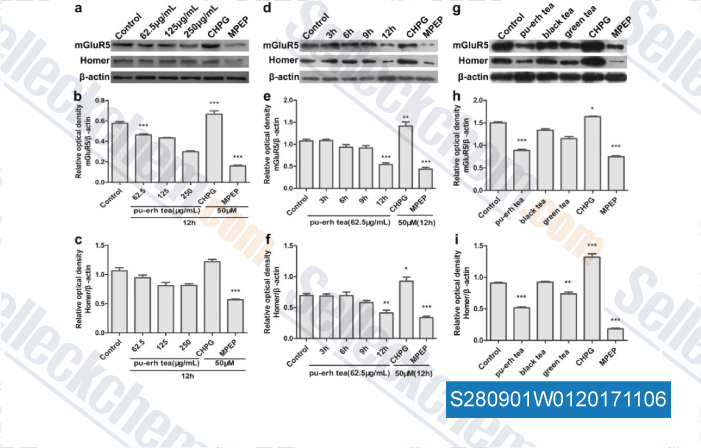
-
Data from [ , , Mol Neurobiol, 2017, 54(7):5286-5299 ]
Selleck's MPEP Has Been Cited by 2 Publications
| Engrafted nitrergic neurons derived from hPSCs improve gut dysmotility in mice [ Nature, 2025, 1-10] | PubMed: 40562934 |
| Pu-erh Tea Protects the Nervous System by Inhibiting the Expression of Metabotropic Glutamate Receptor 5. [Li C, et al. Mol Neurobiol, 2017, 54(7):5286-5299] | PubMed: 27578019 |
RETURN POLICY
Selleck Chemical’s Unconditional Return Policy ensures a smooth online shopping experience for our customers. If you are in any way unsatisfied with your purchase, you may return any item(s) within 7 days of receiving it. In the event of product quality issues, either protocol related or product related problems, you may return any item(s) within 365 days from the original purchase date. Please follow the instructions below when returning products.
SHIPPING AND STORAGE
Selleck products are transported at room temperature. If you receive the product at room temperature, please rest assured, the Selleck Quality Inspection Department has conducted experiments to verify that the normal temperature placement of one month will not affect the biological activity of powder products. After collecting, please store the product according to the requirements described in the datasheet. Most Selleck products are stable under the recommended conditions.
NOT FOR HUMAN, VETERINARY DIAGNOSTIC OR THERAPEUTIC USE.