
|
How to Cite 1. For In-Text Citation (Materials & Methods): 2. For Key Resources Table: |
||
|
Toll Free: (877) 796-6397 -- USA and Canada only -- |
Fax: +1-832-582-8590 Orders: +1-832-582-8158 |
Tech Support: +1-832-582-8158 Ext:3 Please provide your Order Number in the email. We strive to reply to |
Biological Description
| Specificity | MLKL Antibody [M19F23] detects endogenous levels of total MLKL protein. |
|---|---|
| Background | MLKL, recognized as mixed lineage kinase domain-like protein, functions as the terminal effector of necroptosis, a regulated form of necrosis distinct from apoptosis, operating downstream of the receptor-interacting protein kinase 3 (RIPK3) within the necrosome complex to execute plasma membrane rupture. It features an N-terminal four-helix bundle (4HB) domain critical for membrane translocation and a pseudokinase domain that senses phosphorylation signals without catalytic activity. Upon RIPK3-mediated phosphorylation at key sites like T357/S358 in humans or S345 in mice, MLKL undergoes a conformational shift, oligomerizing into amyloid-like filaments that bind phosphatidylinositol phosphates on the inner plasma membrane leaflet, driving non-selective ion channel formation, osmotic imbalance, and rapid cell lysis. This mechanism integrates tightly with RIPK1/RIPK3 signaling initiated by death receptor ligands such as TNF-α under caspase-compromised conditions, where ubiquitylation at lysine 219 further enhances K63-linked chain formation to stabilize higher-order assemblies essential for cytotoxicity and pathogen clearance during infection. Activated MLKL not only terminates necroptosis but triggers concurrent inflammatory cascades by releasing damage-associated molecular patterns (DAMPs), activating the NLRP3 inflammasome for IL-1β maturation independently of gasdermin D, and amplifying chemokine production like IL-6 and MCP-1 to recruit immune effectors, positioning it as a dual regulator of cell death and innate immunity that researchers target to dissect sterile inflammation or microbial defense. MLKL maintains tissue homeostasis by curbing excessive necroptosis in barrier epithelia and neurons, with its deficiency mitigating low-grade sterile inflammation across skeletal muscle, adipose, and connective tissues during aging, while enabling survival advantages against viral challenges through heightened lymphocyte responses. Dysregulation drives pathology in inflammatory bowel disease, where p-MLKL exacerbates epithelial loss and cytokine storms, and neurodegenerative disorders like ALS or PD models, where MLKL knockout reduces neuroinflammation, motor deficits, and α-synuclein toxicity via lowered proinflammatory cytokines. |
Usage Information
| Application | WB, IHC, IF | Dilution |
|
||||||
|---|---|---|---|---|---|---|---|---|---|
| Reactivity | Human | ||||||||
| Source | Rabbit Monoclonal Antibody | MW | 54 kDa | ||||||
| Storage Buffer | PBS, pH 7.2+50% Glycerol+0.05% BSA+0.01% NaN3 | Storage (from the date of receipt) |
-20°C (avoid freeze-thaw cycles), 2 years | ||||||
References
|
Application Data
WB
Validated by Selleck
-
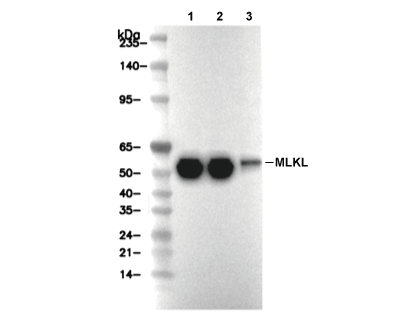 Lane 1: Hela, Lane 2: HUVEC, Lane 3: HT-29