
|
How to Cite 1. For In-Text Citation (Materials & Methods): 2. For Key Resources Table: |
||
|
Toll Free: (877) 796-6397 -- USA and Canada only -- |
Fax: +1-832-582-8590 Orders: +1-832-582-8158 |
Tech Support: +1-832-582-8158 Ext:3 Please provide your Order Number in the email. We strive to reply to |
Biological Description
| Specificity | MKP-5 Antibody [K14L19] detects endogenous levels of total MKP-5 protein. |
|---|---|
| Background | MAP kinase phosphatase 5 (MKP-5, also called DUSP10) is a dual-specificity phosphatase of the MAPK phosphatase family that dephosphorylates threonine and tyrosine residues in the activation loops of stress-activated MAP kinases and acts as a negative regulator of p38 and JNK signaling in immune and metabolic tissues. MKP-5 contains an N-terminal noncatalytic region with a rhodanese-like MAPK interaction domain and a C-terminal protein tyrosine phosphatase domain, belongs to the type III DUSP subfamily, and is predominantly cytosolic, which enables direct action on cytosolic p38 and JNK substrates. In neutrophils, MKP-5 preferentially dephosphorylates p38 MAPK and limits the magnitude and duration of p38 activation after stimulation with C5a, TNF-α, fMLF, or PMA, reducing phosphorylation of the NADPH oxidase subunit p47phox and lowering superoxide generation. Neutrophils from MKP-5-deficient mice show sustained p38 activation, higher p47phox phosphorylation, and markedly increased superoxide production in response to these agonists, and MKP-5 knockout mice develop severe hemorrhagic skin lesions and thrombohemorrhagic vasculitis after a single LPS injection in a modified local Shwartzman reaction, whereas wild-type mice develop only mild lesions under the same conditions. Neutrophil depletion or combined deficiency of MKP-5 and p47phox markedly reduces this LPS-induced vascular injury, and MKP-5-deficient mice display enhanced endothelial damage and vascular permeability in this model. MKP-5 is also expressed in pancreatic β cells, where it dephosphorylates p38 and JNK during glucolipotoxic stress, reduces markers of endoplasmic reticulum stress and mitochondrial apoptotic signaling, decreases inflammatory gene expression and reactive oxygen species levels, and maintains insulin secretory function. Under glucolipotoxic conditions, MKP-5 overexpression in β-cell lines and primary islets improves glucose-stimulated insulin secretion, preserves expression of β-cell functional genes, and lowers caspase activation, whereas MKP-5 knockdown increases p38 and JNK phosphorylation, reduces insulin secretion, and enhances β-cell apoptosis. These findings describe MKP-5 as a cytosolic DUSP with defined structural domains that controls stress-activated MAPK signaling in neutrophils and β cells, modulates NADPH oxidase-dependent oxidant production and LPS-induced vascular injury, and influences β-cell survival and function under metabolic stress. |
Usage Information
| Application | WB, IP, IHC, IF, ELISA | Dilution |
|
||||||||
|---|---|---|---|---|---|---|---|---|---|---|---|
| Reactivity | Human, Mouse, Rat | ||||||||||
| Source | Mouse Monoclonal Antibody | MW | 53 kDa | ||||||||
| Storage Buffer | PBS, pH 7.2+50% Glycerol+0.05% BSA+0.01% NaN3 | Storage (from the date of receipt) |
-20°C (avoid freeze-thaw cycles), 2 years | ||||||||
References
|
Application Data
WB
Validated by Selleck
-
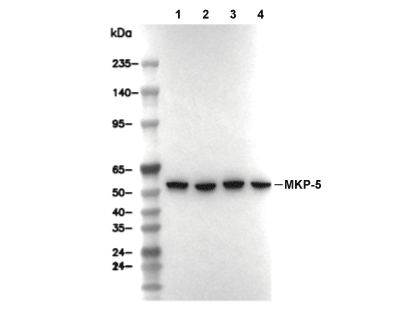 Lane 1: Hela, Lane 2: NIH/3T3, Lane 3: DU 145, Lane 4: PC-3