
|
How to Cite 1. For In-Text Citation (Materials & Methods): 2. For Key Resources Table: |
||
|
Toll Free: (877) 796-6397 -- USA and Canada only -- |
Fax: +1-832-582-8590 Orders: +1-832-582-8158 |
Tech Support: +1-832-582-8158 Ext:3 Please provide your Order Number in the email. We strive to reply to |
Biological Description
| Specificity | Mili Antibody [K20L16] detects endogenous levels of total Mili protein. |
|---|---|
| Background | Mili functions as a key member of the PIWI subfamily within the Argonaute protein family, alongside Miwi and Miwi2, where it specifically associates with Piwi-interacting RNAs (piRNAs) to safeguard genomic integrity during mammalian spermatogenesis. Mili contains a conserved PAZ domain that anchors the 3' end of piRNAs and a MID domain that clamps the 5' end, coupled to a slicer-competent PIWI domain that enables endonucleolytic cleavage of complementary transcripts while facilitating interactions with Tudor-domain proteins through symmetric dimethylarginine modifications on its N-terminal tail. Primary piRNA biogenesis initiates with Mili binding long single-stranded precursors in the cytoplasm of prospermatogonia, where it licenses phased slicing that generates 5' monophosphorylated intermediates for loading onto secondary PIWI proteins, establishing a ping-pong amplification cycle that populates nuage and chromatoid bodies with transposon-targeting piRNAs. Interaction with MVH helicase unwinds precursor duplexes to expose targets, while Tudor domain-containing protein 1 (TDRD1) scaffolds Mili within cytoplasmic granules to concentrate piRNA-directed silencing machinery, coordinating mRNA deadenylation and decay of retrotransposon transcripts like LINE1 and IAP that threaten meiotic progression. Mili further engages translational initiation factors eIF4G and eIF3A to selectively repress or stabilize germ cell-specific mRNAs, integrating piRNA-guided cleavage with post-transcriptional control during germ granule maturation. Mili sustains germline stem cell self-renewal and spermatogonial differentiation by restricting transposon mobility, with peak expression from embryonic prospermatogonia through early pachytene spermatocytes reflecting stage-specific piRNA repertoire expansion. Dysregulation through Mili depletion arrests spermatogenesis at the spermatocyte stage, unleashing transposon derepression that compromises meiotic chromosome pairing and DNA methylation at retroelement loci. |
Usage Information
| Application | WB, IP, IHC, IF | Dilution |
|
||||||||
|---|---|---|---|---|---|---|---|---|---|---|---|
| Reactivity | Mouse | ||||||||||
| Source | Rabbit Monoclonal Antibody | MW | 110 kDa | ||||||||
| Storage Buffer | PBS, pH 7.2+50% Glycerol+0.05% BSA+0.01% NaN3 | Storage (from the date of receipt) |
-20°C (avoid freeze-thaw cycles), 2 years | ||||||||
References
|
Application Data
WB
Validated by Selleck
-
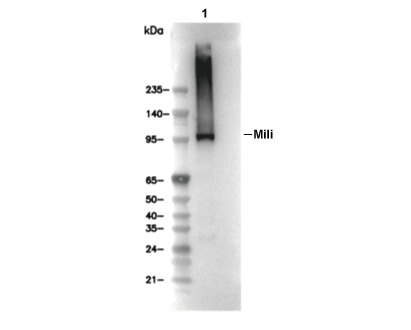 Lane 1: Mouse testis