
|
How to Cite 1. For In-Text Citation (Materials & Methods): 2. For Key Resources Table: |
||
|
Toll Free: (877) 796-6397 -- USA and Canada only -- |
Fax: +1-832-582-8590 Orders: +1-832-582-8158 |
Tech Support: +1-832-582-8158 Ext:3 Please provide your Order Number in the email. We strive to reply to |
Biological Description
| Specificity | MICB Antibody [C17D9] detects endogenous levels of total MICB protein. |
|---|---|
| Background | MHC class I polypeptide‑related sequence B (MICB) is a stress‑inducible, MHC class I–like transmembrane glycoprotein encoded within the human MHC region that functions as a ligand for the activating receptor NKG2D on natural killer cells, CD8 αβ T cells, and γδ T cells, thereby linking cellular stress to innate and adaptive cytotoxic responses. The extracellular portion adopts an MHC I–type fold with α1, α2, and α3 domains but does not associate with β2‑microglobulin or present processed peptides, and instead serves as a recognition platform for NKG2D, while the short transmembrane and cytoplasmic regions anchor MICB in the plasma membrane and permit regulated expression and shedding. Expression of MICB is low or absent in most healthy tissues and is upregulated by stress pathways, including heat shock and DNA damage responses, through promoter elements such as heat shock response elements and other stress‑responsive motifs, so that infected, transformed, or otherwise stressed epithelial and hematopoietic cells display MICB as a “danger” signal. Engagement of MICB on target cells with NKG2D on NK and T cells provides a strong co‑stimulatory or activating signal that enhances cytotoxic granule release and cytokine production and can cooperate with TCR or other receptor inputs to promote efficient killing of MICB‑positive targets. MICB is coexpressed with the closely related ligand MICA and with ULBP family ligands in many tumors and virally infected cells, and the overall pattern and density of NKG2D ligands determine sensitivity to NK‑ and CD8 T‑cell‑mediated cytotoxicity. Tumor cells frequently counteract MICB‑mediated recognition by reducing surface expression or by releasing soluble MICB through proteolytic shedding; soluble MICA/B downregulate NKG2D on effector cells and weaken anti‑tumor immunity, which makes MICB expression and shedding important variables in tumor immune evasion. MICB expression has been documented across diverse carcinomas and hematologic malignancies with variable prevalence, and its presence often correlates with an inflamed microenvironment and NK/T‑cell infiltration, whereas loss or intracellular retention of MICB associates with more advanced or immune‑evasive phenotypes. Genetic variation and transcriptional control of MICB also connect this ligand to autoimmune and inflammatory conditions, where altered NKG2D ligand expression can modulate tissue damage by autoreactive cytotoxic lymphocytes. |
Usage Information
| Application | WB, IP, IF, FCM | Dilution |
|
||||||||
|---|---|---|---|---|---|---|---|---|---|---|---|
| Reactivity | Human | ||||||||||
| Source | Rabbit Monoclonal Antibody | MW | 43 kDa | ||||||||
| Storage Buffer | PBS, pH 7.2+50% Glycerol+0.05% BSA+0.01% NaN3 | Storage (from the date of receipt) |
-20°C (avoid freeze-thaw cycles), 2 years | ||||||||
References
|
Application Data
WB
Validated by Selleck
-
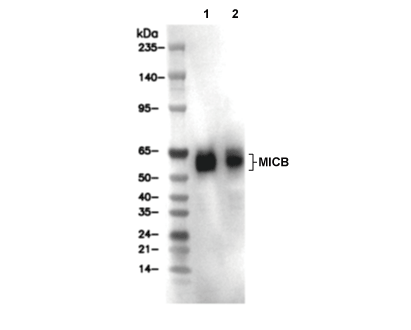 Lane 1: K562, Lane 2: U266