
|
How to Cite 1. For In-Text Citation (Materials & Methods): 2. For Key Resources Table: |
||
|
Toll Free: (877) 796-6397 -- USA and Canada only -- |
Fax: +1-832-582-8590 Orders: +1-832-582-8158 |
Tech Support: +1-832-582-8158 Ext:3 Please provide your Order Number in the email. We strive to reply to |
Biological Description
| Specificity | Lysozyme C Antibody [J12N14] detects endogenous levels of total Lysozyme C protein. |
|---|---|
| Background | Lysozyme C belongs to the conventional c-type family of bacteriolytic enzymes pivotal for innate immunity across mammals, where it hydrolyzes β-1,4-glycosidic linkages between N-acetylmuramic acid and N-acetylglucosamine in bacterial peptidoglycan, disrupting cell wall integrity to facilitate microbial clearance. Encoded by the human LYZ gene and its mouse orthologs Lyz1 and Lyz2, it features a compact fold with alpha helices and beta sheets forming a substrate-binding cleft that positions key catalytic residues, notably Glu35 and Asp52, to stabilize the transition state during hydrolysis through a mechanism involving acid-base catalysis and covalent intermediate formation at Asp52. Secreted into mucosal fluids such as tears, saliva, milk, and urine, as well as produced by phagocytes including macrophages, neutrophils, and dendritic cells, Lysozyme C engages peptidoglycan via its active site cleft, inducing strain on the scissile bond before protonation by Glu35 and nucleophilic attack, yielding cleavage products that weaken Gram-positive bacterial walls. In microglia, the brain-resident macrophages, Lyz1 and Lyz2 exhibit unique expression, with Lyz2 upregulation occurring in Alzheimer's disease models following neuronal activity stimulation, correlating directly with enhanced β-amyloid phagocytosis and degradation. Lysozyme interacts physically with amyloid-β42, binding monomers and oligomers to redirect aggregation pathways away from toxic species, as observed in neuronal co-expression reducing soluble and insoluble amyloid-β levels while preserving fly viability and locomotion in Drosophila models. Elevated cerebrospinal fluid levels accompany amyloid plaque colocalization in human Alzheimer's brains and transgenic mice, positioning Lysozyme C as a responsive element in neuroinflammatory responses that modulates plaque-associated pathologies without altering total amyloid-β production. |
Usage Information
| Application | WB, IHC | Dilution |
|
||||
|---|---|---|---|---|---|---|---|
| Reactivity | Human | ||||||
| Source | Rabbit Monoclonal Antibody | MW | 15 kDa | ||||
| Storage Buffer | PBS, pH 7.2+50% Glycerol+0.05% BSA+0.01% NaN3 | Storage (from the date of receipt) |
-20°C (avoid freeze-thaw cycles), 2 years | ||||
References
|
Application Data
WB
Validated by Selleck
-
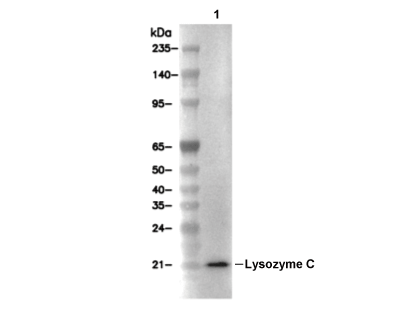 Lane 1: U937