
|
How to Cite 1. For In-Text Citation (Materials & Methods): 2. For Key Resources Table: |
||
|
Toll Free: (877) 796-6397 -- USA and Canada only -- |
Fax: +1-832-582-8590 Orders: +1-832-582-8158 |
Tech Support: +1-832-582-8158 Ext:3 Please provide your Order Number in the email. We strive to reply to |
Biological Description
| Specificity | Legumain Antibody [N22H22] detects endogenous levels of total Legumain protein. |
|---|---|
| Background | Legumain stands as the sole mammalian asparaginyl endopeptidase within the C13 protease family, primarily residing in late endolysosomes, where it processes antigens for MHC class II presentation and cleaves peptide bonds after asparagine residues. It incorporates a catalytic triad of cysteine, histidine, and asparagine, shielded by an N-terminal propeptide in the zymogen form, alongside an LSAM domain that stabilizes activity across pH ranges through interactions with the catalytic core. Activation proceeds via dual routes: acid-induced conformational shifts at low pH unmask endopeptidase function by protonating the S1 pocket and catalytic cysteine, while proteolytic cleavage at near-neutral pH liberates an activation peptide to yield a carboxypeptidase mode, with autolytic beta-cleavage at an Asn-Asp bond completing maturation and enabling homodimer formation for enhanced substrate access. This versatility allows legumain to traffic from lysosomes to extracellular spaces or the nucleus, where it sustains stability via LSAM-mediated occlusion of the active site against denaturation. In antigen-presenting cells, legumain trims invariant chain fragments to optimize peptide loading onto MHC II, coordinating Toll-like receptor signaling with lysosomal maturation pathways. Nuclear translocation exposes legumain to chromatin substrates like histone H3, generating cleavages that alter nucleosome integrity and influence gene accessibility during stress or differentiation cues. Legumain governs extracellular matrix remodeling through progranulin processing and supports immune tolerance by balancing Th1/Th2 responses via antigen selection. Elevated expression accompanies tumor progression in colorectal and other solid cancers, with nuclear and secreted pools correlating to dedifferentiation, necrosis, and metastasis via enhanced proliferative and invasive signaling through p53 and stromelysin pathways. |
Usage Information
| Application | WB, IHC | Dilution |
|
||||
|---|---|---|---|---|---|---|---|
| Reactivity | Human, Mouse, Rat | ||||||
| Source | Rabbit Monoclonal Antibody | MW | 25, 35, 55 kDa | ||||
| Storage Buffer | PBS, pH 7.2+50% Glycerol+0.05% BSA+0.01% NaN3 | Storage (from the date of receipt) |
-20°C (avoid freeze-thaw cycles), 2 years | ||||
References
|
Application Data
WB
Validated by Selleck
-
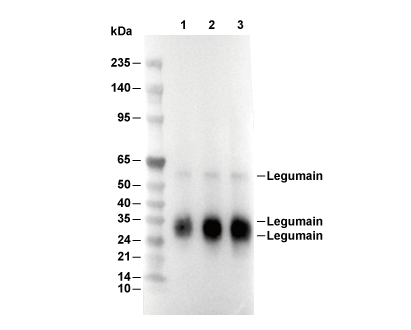 Lane 1: Human kidney, Lane 2: Mouse kidney, Lane 3: Rat kidney