
|
How to Cite 1. For In-Text Citation (Materials & Methods): 2. For Key Resources Table: |
||
|
Toll Free: (877) 796-6397 -- USA and Canada only -- |
Fax: +1-832-582-8590 Orders: +1-832-582-8158 |
Tech Support: +1-832-582-8158 Ext:3 Please provide your Order Number in the email. We strive to reply to |
Technical Data
| Formula | C33H37F2N7O4 |
||||||||||
| Molecular Weight | 633.69 | CAS No. | 928037-13-2 | ||||||||
| Solubility (25°C)* | In vitro | DMSO | 20 mg/mL (31.56 mM) | ||||||||
| Water | Insoluble | ||||||||||
| Ethanol | Insoluble | ||||||||||
| In vivo (Add solvents to the product individually and in order) |
|
||||||||||
|
* <1 mg/ml means slightly soluble or insoluble. * Please note that Selleck tests the solubility of all compounds in-house, and the actual solubility may differ slightly from published values. This is normal and is due to slight batch-to-batch variations. * Room temperature shipping (Stability testing shows this product can be shipped without any cooling measures.) |
|||||||||||
Preparing Stock Solutions
Biological Activity
| Description | Golvatinib (E7050) is a dual c-Met and VEGFR-2 inhibitor with IC50 of 14 nM and 16 nM, respectively. This compound does not inhibit bFGF-stimulated HUVEC growth (up to 1000 nM) and is currently in Phase 1/2 trials. | ||||
|---|---|---|---|---|---|
| Targets |
|
||||
| In vitro | In vitro studies indicate that Golvatinib (E7050) potently inhibits phosphorylation of both c-Met and VEGFR-2. It also potently represses the growth of both c-met amplified tumor cells and endothelial cells stimulated with either HGF or VEGF. This compound circumvents resistance to all of the reversible, irreversible, and mutant-selective EGFR-TKIs induced by exogenous and/or endogenous HGF in EGFR mutant lung cancer cell lines, by blocking the Met/Gab1/PI3K/Akt pathway in vitro. It also prevents the emergence of gefitinib-resistant HCC827 cells induced by continuous exposure to HGF. | ||||
| In vivo | Golvatinib (E7050) shows inhibition of the phosphorylation of c-Met and VEGFR-2 in tumors in vivo, with strong suppression of tumor growth and angiogenesis in xenograft models. Treatment of some tumor lines containing c-met amplifications with high doses of this compound (50–200 mg/kg) induces tumor regression and disappearance. In a peritoneal dissemination model, it demonstrates an antitumor effect against peritoneal tumors as well as a significant prolongation of lifespan in treated mice. In another xenograft study, tumors produced by HGF-transfected Ma-1 (Ma-1/HGF) cells are more angiogenic than vector control tumors and show resistance to ZD1839. E7050 alone inhibits angiogenesis and retards growth of Ma-1/HGF tumors, and when combined with ZD1839, it induces marked regression of tumor growth. |
Protocol (from reference)
| Kinase Assay:[1] |
|
|---|---|
| Cell Assay:[1] |
|
| Animal Study:[1] |
|
References
|
Customer Product Validation
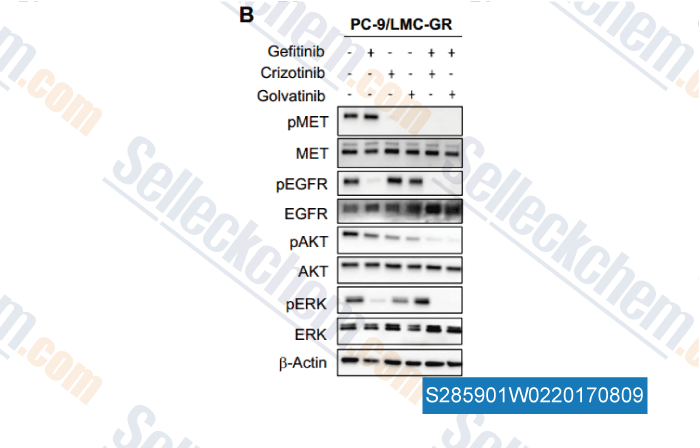
-
Data from [ , , Mol Cancer Ther, 2017, 16(3):506-515 ]
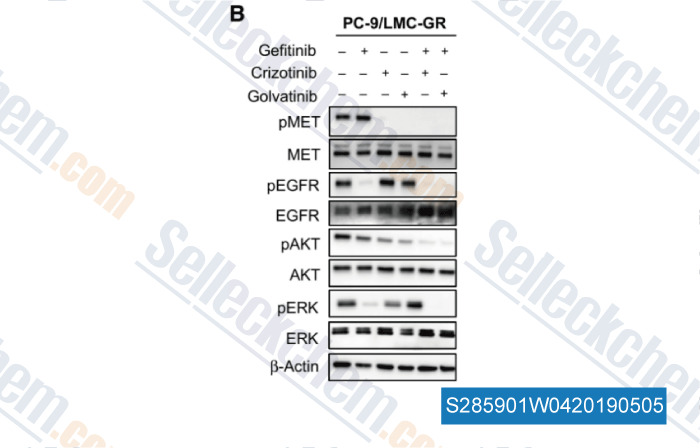
-
Data from [ , , Mol Cancer Ther, 2017, 16(3):506-515 ]
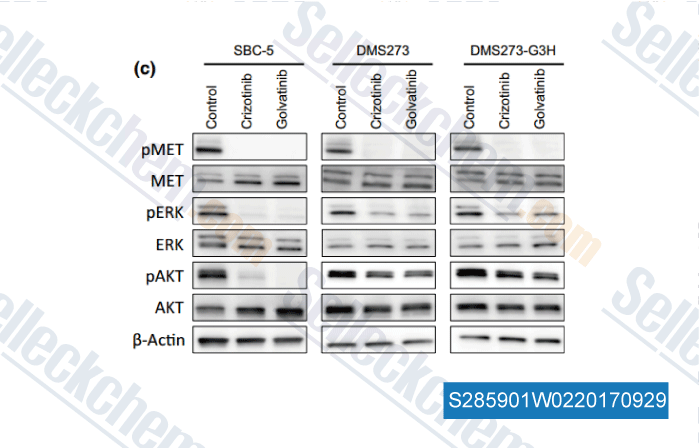
-
Data from [ , , Cancer Sci, 2017, 108(7):1378-1385 ]
Selleck's Golvatinib (E7050) Has Been Cited by 15 Publications
| E7050 Suppresses the Growth of Multidrug-Resistant Human Uterine Sarcoma by Inhibiting Angiogenesis via Targeting of VEGFR2-Mediated Signaling Pathways [ Int J Mol Sci, 2023, 24(11)9606] | PubMed: 37298555 |
| E7050 Suppresses the Growth of Multidrug-Resistant Human Uterine Sarcoma by Inhibiting Angiogenesis via Targeting of VEGFR2-Mediated Signaling Pathways [ International Journal of Molecular Sciences, 2023, 9606] | PubMed: 37298555 |
| Blockade of c-Met-Mediated Signaling Pathways by E7050 Suppresses Growth and Promotes Apoptosis in Multidrug-Resistant Human Uterine Sarcoma Cells [ International Journal of Molecular Sciences, 2022, 14884] | PubMed: 36499211 |
| Blockade of c-Met-Mediated Signaling Pathways by E7050 Suppresses Growth and Promotes Apoptosis in Multidrug-Resistant Human Uterine Sarcoma Cells [ Int J Mol Sci, 2022, 23(23)14884] | PubMed: 36499211 |
| MET amplification results in heterogeneous responses to osimertinib in EGFR‐mutant lung cancer treated with erlotinib [ Cancer Science, 2020, 3813-3823] | PubMed: 32735723 |
| MET amplification results in heterogeneous responses to osimertinib in EGFR-mutant lung cancer treated with erlotinib [ Cancer Sci, 2020, 111(10):3813-3823] | PubMed: 32735723 |
| Diverse Receptor Tyrosine Kinase Phosphorylation in Urine-Derived Tubular Epithelial Cells from Autosomal Dominant Polycystic Kidney Disease Patients [ Nephron, 2020, 525-536] | PubMed: 32799196 |
| Diverse Receptor Tyrosine Kinase Phosphorylation in Urine-Derived Tubular Epithelial Cells from Autosomal Dominant Polycystic Kidney Disease Patients [ Nephron, 2020, 1-12] | PubMed: 32799196 |
| LECT2, a Ligand for Tie1, Plays a Crucial Role in Liver Fibrogenesis [ Cell, 2019, 178(6):1478-1492] | PubMed: 31474362 |
| MET Copy Number Gain Is Associated with Gefitinib Resistance in Leptomeningeal Carcinomatosis of EGFR-mutant Lung Cancer [ Molecular Cancer Therapeutics, 2017 Mar, 506-515] | PubMed: 28138027 |
RETURN POLICY
Selleck Chemical’s Unconditional Return Policy ensures a smooth online shopping experience for our customers. If you are in any way unsatisfied with your purchase, you may return any item(s) within 7 days of receiving it. In the event of product quality issues, either protocol related or product related problems, you may return any item(s) within 365 days from the original purchase date. Please follow the instructions below when returning products.
SHIPPING AND STORAGE
Selleck products are transported at room temperature. If you receive the product at room temperature, please rest assured, the Selleck Quality Inspection Department has conducted experiments to verify that the normal temperature placement of one month will not affect the biological activity of powder products. After collecting, please store the product according to the requirements described in the datasheet. Most Selleck products are stable under the recommended conditions.
NOT FOR HUMAN, VETERINARY DIAGNOSTIC OR THERAPEUTIC USE.