
|
How to Cite 1. For In-Text Citation (Materials & Methods): 2. For Key Resources Table: |
||
|
Toll Free: (877) 796-6397 -- USA and Canada only -- |
Fax: +1-832-582-8590 Orders: +1-832-582-8158 |
Tech Support: +1-832-582-8158 Ext:3 Please provide your Order Number in the email. We strive to reply to |
Biological Description
| Specificity | Glutathione Peroxidase 4 Antibody [P24F22] detects endogenous levels of total Glutathione Peroxidase 4 protein. |
|---|---|
| Background | GPX4 (glutathione peroxidase 4) is a selenocysteine‑containing glutathione peroxidase that occupies a unique position in redox biology as the only enzyme that directly reduces complex phospholipid and cholesterol hydroperoxides within biological membranes and lipoproteins, using reduced glutathione as an electron donor and thereby maintaining the integrity of polyunsaturated phospholipids that are otherwise highly susceptible to iron‑driven peroxidation. The protein is a monomeric oxidoreductase whose catalytic center contains a selenocysteine residue that cycles between selenol and selenenic/selenyl–glutathione intermediates during the reaction 2 GSH + phospholipid–OOH → GSSG + phospholipid–OH + H₂O, and this capacity to act directly on membrane‑embedded hydroperoxides differentiates GPX4 from other family members that primarily handle soluble peroxides. GPX4 activity is central to suppression of ferroptosis, a regulated necrotic death pathway driven by unchecked iron‑dependent lipid peroxidation: loss or inhibition of GPX4 function causes accumulation of phospholipid hydroperoxides beyond a toxic threshold, collapse of membrane structure, and execution of ferroptotic death, whereas preserved GPX4 activity is sufficient to interrupt lipid peroxidation chain reactions and maintain cell viability despite high oxidative load. This function places GPX4 at the heart of the Xc⁻/GSH/GPX4 axis, in which cystine import via system Xc⁻, glutathione synthesis, and GPX4 activity form a linear defense against ferroptosis that is transcriptionally supported by Nrf2 and other stress‑response factors; disruption at any step sensitizes cells to ferroptosis, while selenium availability and selenocysteine incorporation into GPX4 are rate‑limiting determinants of its expression and activity. Isoforms of GPX4 localize to cytosol, mitochondria, and nucleus/testis, extending its protective role to mitochondrial membranes and chromatin‑associated lipids and making it essential for embryonic development, spermatogenesis, and long‑term neuronal survival, where GPX4 maintains synaptic and myelin membrane integrity and limits neurodegenerative cascades triggered by lipid peroxidation. Dysregulated GPX4 expression or activity contributes to diverse pathologies: impaired GPX4 promotes ferroptosis in ischemia–reperfusion injury, neurodegeneration, and inflammatory tissue damage, while GPX4 overexpression or enforced dependency characterizes many therapy‑resistant and high‑mesenchymal‑state cancer cells, including drug‑tolerant persister subpopulations that rely on GPX4‑mediated detoxification of lipid peroxides for survival under chemotherapy or targeted therapy pressure. |
Usage Information
| Application | WB, IHC | Dilution |
|
||||
|---|---|---|---|---|---|---|---|
| Reactivity | Human, Mouse, Rat | ||||||
| Source | Rabbit Monoclonal Antibody | MW | 22 kDa | ||||
| Storage Buffer | PBS, pH 7.2+50% Glycerol+0.05% BSA+0.01% NaN3 | Storage (from the date of receipt) |
-20°C (avoid freeze-thaw cycles), 2 years | ||||
References
|
Application Data
WB
Validated by Selleck
-
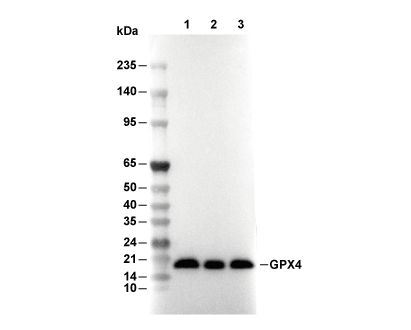 Lane 1: 22Rv1, Lane 2: U-118 MG, Lane 3: U-937