
|
How to Cite 1. For In-Text Citation (Materials & Methods): 2. For Key Resources Table: |
||
|
Toll Free: (877) 796-6397 -- USA and Canada only -- |
Fax: +1-832-582-8590 Orders: +1-832-582-8158 |
Tech Support: +1-832-582-8158 Ext:3 Please provide your Order Number in the email. We strive to reply to |
Biological Description
| Specificity | Gasdermin D Antibody [B17C12] detects endogenous levels of total Gasdermin D protein. |
|---|---|
| Background | Gasdermin D (GSDMD) is a pore-forming member of the gasdermin family that functions as the central executioner of inflammasome-dependent pyroptosis and links inflammatory caspase activity to membrane rupture and cytokine release. The protein contains an N-terminal effector domain with intrinsic membrane-perforating capacity and a C-terminal autoinhibitory domain joined by a linker that carries the conserved caspase cleavage site, and this arrangement maintains GSDMD in a latent conformation until site-specific proteolysis occurs. Canonical and noncanonical inflammasomes activate caspase-1 and caspase-4/5/11, which cleave the linker to liberate the N-terminal fragment from C-terminal restraint, allowing the N-terminus to translocate to phospholipid-rich membranes and initiate pyroptotic execution. The liberated N-terminal fragment binds acidic phospholipids in the inner leaflet of the plasma membrane and other cellular membranes, oligomerizes into large ring-like complexes, and assembles variable-sized pores that disrupt ionic balance, drive water influx, and generate the characteristic swelling and lytic rupture of pyroptotic cell death. These pores provide conduits for unconventional secretion of mature interleukin-1 family cytokines, including IL-1β and IL-18, and allow the release of alarmins and intracellular contents that amplify local and systemic inflammation. Structural and biochemical analyses place cysteine residues and defined interface surfaces in the N-terminal domain as critical modulators of oligomerization and pore architecture, while the C-terminal region contributes interaction motifs that stabilize the inactive state and may integrate upstream regulatory inputs. GSDMD activity intersects with membrane repair, lipid composition, and post-translational modifications, which collectively determine the number, stability, and localization of pores and thereby tune whether cells undergo full lysis or primarily secrete cytokines through a partially preserved plasma membrane. GSDMD-mediated pore formation contributes to pathogen clearance, inflammasome-driven cytokine signaling, and neutrophil effector mechanisms, while dysregulated or sustained activation drives tissue damage and chronic inflammation in diverse organs. Aberrant GSDMD activation is linked to inflammatory diseases of the cardiovascular system, liver, pancreas, and other tissues, where excessive pyroptosis and cytokine release promote persistent inflammatory microenvironments and organ dysfunction. |
Usage Information
| Application | WB, IP, IHC, IF | Dilution |
|
||||||||
|---|---|---|---|---|---|---|---|---|---|---|---|
| Reactivity | Human | ||||||||||
| Source | Rabbit Monoclonal Antibody | MW | 53 kDa | ||||||||
| Storage Buffer | PBS, pH 7.2+50% Glycerol+0.05% BSA+0.01% NaN3 | Storage (from the date of receipt) |
-20°C (avoid freeze-thaw cycles), 2 years | ||||||||
References
|
Application Data
WB
Validated by Selleck
-
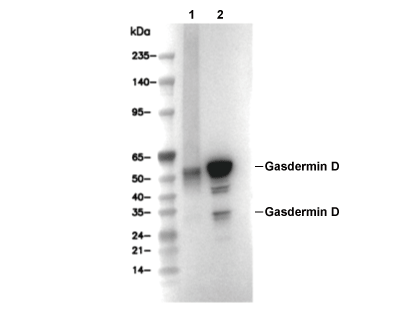 Lane 1: THP-1 (TPA, 50 ng/mL, 24 h; rested 48 h), Lane 2: THP-1 (TPA, 50 ng/mL, 24 h; rested 48 h; LPS, 5 μg/mL, 6 h)