
|
How to Cite 1. For In-Text Citation (Materials & Methods): 2. For Key Resources Table: |
||
|
Toll Free: (877) 796-6397 -- USA and Canada only -- |
Fax: +1-832-582-8590 Orders: +1-832-582-8158 |
Tech Support: +1-832-582-8158 Ext:3 Please provide your Order Number in the email. We strive to reply to |
Biological Description
| Specificity | Fibronectin Antibody [P19B9] detects endogenous levels of total Fibronectin protein. |
|---|---|
| Background | Fibronectin, a versatile glycoprotein central to extracellular matrix assembly, facilitates cell adhesion, migration, and tissue organization by binding integrins, collagen, fibrin, heparin, DNA, and actin to orchestrate dynamic matrix remodeling. Its modular architecture includes type I, II, and III repeats, with the RGD loop in the 10th type III domain mediating integrin engagement and N-terminal modules driving cell-directed fibrillogenesis through conformational unfolding. Upon integrin α5β1 or αvβ3 ligation, fibronectin activates FAK-Src signaling, recruiting PI3K to inhibit Hippo kinases MST1/2-LATS1/2, thereby dephosphorylating YAP/TAZ for nuclear entry and transcription of proliferative genes like CTGF and CYR61, while RhoA effector ROCK promotes actin bundling essential for fibril extension and force transmission. The fragment anastellin binds fibronectin to catalyze rapid polymerization into superfibronectin, a super-adhesive matrix that heightens integrin clustering, potently activates p38 MAPK independently of β1 integrins, even in suspension, while suppressing lysophosphatidic acid (LPA) and sphingosine-1-phosphate (S1P) signaling through Ras/ERK inhibition, curtailing endothelial migration and vessel sprouting. These actions drive physiological processes like osteoblast compaction for bone mineralization, wound closure via directed motility, and muscle-secreted induction of hepatic autophagy through ITGA5-ITGB1 for insulin sensitization during exercise. Excessive fibril deposition underlies fibrosis and tumor progression, where aberrant signaling fosters invasion. |
Usage Information
| Application | WB, IF, FCM | Dilution |
|
||||||
|---|---|---|---|---|---|---|---|---|---|
| Reactivity | Mouse, Rat, Human | ||||||||
| Source | Rabbit Monoclonal Antibody | MW | 262 kDa, 272 kDa | ||||||
| Storage Buffer | PBS, pH 7.2+50% Glycerol+0.05% BSA+0.01% NaN3 | Storage (from the date of receipt) |
-20°C (avoid freeze-thaw cycles), 2 years | ||||||
References
|
Application Data
WB
Validated by Selleck
-
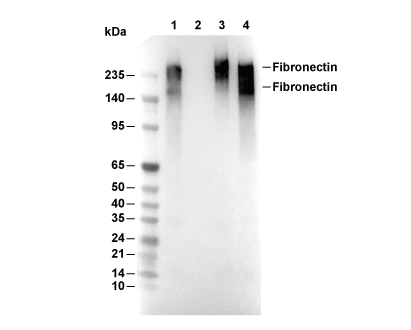 Lane 1: MCF7, Lane 2: MCF7 (KO Human FN1), Lane 3: HepG2, Lane 4: PC-3