
|
How to Cite 1. For In-Text Citation (Materials & Methods): 2. For Key Resources Table: |
||
|
Toll Free: (877) 796-6397 -- USA and Canada only -- |
Fax: +1-832-582-8590 Orders: +1-832-582-8158 |
Tech Support: +1-832-582-8158 Ext:3 Please provide your Order Number in the email. We strive to reply to |
Biological Description
| Specificity | Fez1 Antibody (Rabbit mAb) [F20M11] detects endogenous levels of total Fez1 protein. |
|---|---|
| Background | FEZ1 is the mammalian ortholog of the Caenorhabditis elegans protein UNC-76, a gene originally identified for its requirement in axonal outgrowth and fasciculation, and FEZ1 was subsequently isolated in a yeast two-hybrid screen specifically as a binding partner of the regulatory domain of protein kinase C zeta, establishing FEZ1 as a direct downstream target of PKCζ signaling. In COS-7 cells, FEZ1 partitions between cytosolic and membrane-associated pools, and phosphorylation of FEZ1 by PKCζ drives redistribution of the membrane-bound fraction into the cytosol, while in PC12 cells this same PKCζ-dependent phosphorylation of FEZ1 stimulates neurite outgrowth, directly linking a single phosphorylation event to a defined change in both subcellular localization and neuronal differentiation behavior. FEZ1 functions structurally as a bivalent cargo adaptor, homodimerizing through its N-terminal region while engaging kinesin motor proteins and additional cargo-associated partners through its C-terminal region; nuclear magnetic resonance analysis shows that this N-terminal homodimerization occurs with the two FEZ1 chains oriented in an antiparallel topology, and biochemical characterization confirms the dimer is further stabilized by an intermolecular disulfide bond formed at a specific cysteine residue within the dimerization interface. This bivalent adaptor architecture is functionally conserved with the C. elegans UNC-76 protein, since UNC-76 similarly binds directly to the C-terminal tail domain of conventional kinesin heavy chain, forming a stable complex in vivo, and loss of UNC-76 function produces locomotion and axonal transport defects that phenocopy kinesin loss-of-function mutants, with UNC-76 additionally showing dosage-sensitive genetic interactions with both kinesin heavy chain and kinesin light chain mutations, together indicating that UNC-76/FEZ1 and kinesin-1 operate within a shared, mechanistically coupled transport pathway rather than through independent, parallel routes. FEZ1-SCOCO adaptor complex, using cross-linking mass spectrometry, small-angle X-ray scattering, and computational modeling, identifies an interaction interface consistent with that previously demonstrated for the UNC-76-UNC-69 complex in C. elegans, and this evidence supports a heterotetrameric assembly model for the transport machinery, indicating that FEZ1 recruits multiple adaptor partners into a single higher-order complex rather than functioning purely as a monomeric or dimeric kinesin linker. |
Usage Information
| Application | WB, FCM, ELISA | Dilution |
|
||||
|---|---|---|---|---|---|---|---|
| Reactivity | Human, Rat, Mouse | ||||||
| Source | Rabbit Monoclonal Antibody | MW | 45 kDa | ||||
| Storage Buffer | PBS, pH 7.2+50% Glycerol+0.05% BSA+0.01% NaN3 | Storage (from the date of receipt) |
-20°C (avoid freeze-thaw cycles), 2 years | ||||
| WB |
Experimental Protocol:
Sample preparation
1. Tissue: Lyse the tissue sample by adding an appropriate volume of ice-cold RIPA/NP-40 Lysis Buffer (containing Protease Inhibitor Cocktail),and homogenize the tissue at a low temperature or lyse it by sonication on ice, then incubate on ice for 30 minutes. 2. Adherent cell: Aspirate the culture medium and wash the cells with ice-cold PBS twice. Lyse the cells by adding an appropriate volume of RIPA/NP-40 Lysis Buffer (containing Protease Inhibitor Cocktail) , sonicate to lyse the cells, and incubate on ice for 30 minutes. 3. Suspension cell: Transfer the culture medium to a pre-cooled centrifuge tube. Centrifuge and aspirate the supernatant. Wash the cells with ice-cold PBS twice. Lyse the cells by adding an appropriate volume of RIPA/NP-40 Lysis Buffer (containing Protease Inhibitor Cocktail) , sonicate to lyse the cells, and incubate on ice for 30 minutes. 4. Place the lysate into a pre-cooled microcentrifuge tube. Centrifuge at 4°C for 15 min. Collect the supernatant;
5. Remove a small volume of lysate to determine the protein concentration;
6. Combine the lysate with protein loading buffer. Boil 20 µL sample under 95-100°C for 5 min. Centrifuge for 5 min after cool down on ice.
Electrophoretic separation
1. According to the concentration of extracted protein, load appropriate amount of protein sample and marker onto SDS-PAGE gels for electrophoresis. Recommended separating gel (lower gel) concentration: 10%. Reference Table for Selecting SDS-PAGE Separation Gel Concentrations 2. Power up 80V for 30 minutes. Then the power supply is adjusted (110 V~150 V), the Marker is observed, and the electrophoresis can be stopped when the indicator band of the predyed protein Marker where the protein is located is properly separated. (Note that the current should not be too large when electrophoresis, too large current (more than 150 mA) will cause the temperature to rise, affecting the result of running glue. If high currents cannot be avoided, an ice bath can be used to cool the bath.)
Transfer membrane
1. Take out the converter, soak the clip and consumables in the pre-cooled converter;
2. Activate PVDF membrane with methanol for 1 min and rinse with transfer buffer;
3. Install it in the order of "black edge of clip - sponge - filter paper - filter paper - glue -PVDF membrane - filter paper - filter paper - sponge - white edge of clip"; 4. The protein was electrotransferred to PVDF membrane. ( 0.45 µm PVDF membrane is recommended ) Reference Table for Selecting PVDF Membrane Pore Size Specifications Recommended conditions for wet transfer: 200 mA, 120 min. ( Note that the transfer conditions can be adjusted according to the protein size. For high-molecular-weight proteins, a higher current and longer transfer time are recommended. However, ensure that the transfer tank remains at a low temperature to prevent gel melting.)
Block
1. After electrotransfer, wash the film with TBST at room temperature for 5 minutes;
2. Incubate the film in the blocking solution for 1 hour at room temperature;
3. Wash the film with TBST for 3 times, 5 minutes each time.
Antibody incubation
1. Use primary antibody dilution buffer to prepare the primary antibody working liquid (recommended dilution ratio for primary antibody 1:1000), gently shake and incubate with the film at 4°C overnight; 2. Wash the film with TBST 3 times, 5 minutes each time;
3. Add the secondary antibody to the blocking solution and incubate with the film gently at room temperature for 1 hour;
4. After incubation, wash the film with TBST 3 times for 5 minutes each time.
Antibody staining
1. Add the prepared ECL luminescent substrate (or select other color developing substrate according to the second antibody) and mix evenly;
2. Incubate with the film for 1 minute, remove excess substrate (keep the film moist), wrap with plastic film, and expose in the imaging system.
|
References
|
Application Data
WB
Validated by Selleck
-
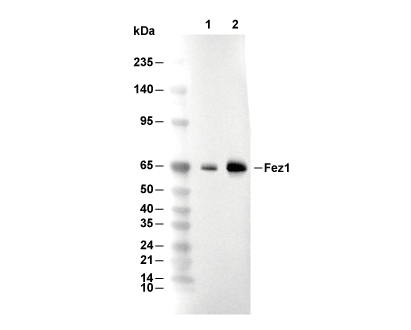 Lane 1: Mouse brain, Lane 2: Rat brain