
|
How to Cite 1. For In-Text Citation (Materials & Methods): 2. For Key Resources Table: |
||
|
Toll Free: (877) 796-6397 -- USA and Canada only -- |
Fax: +1-832-582-8590 Orders: +1-832-582-8158 |
Tech Support: +1-832-582-8158 Ext:3 Please provide your Order Number in the email. We strive to reply to |
Biological Description
| Specificity | Emerin Antibody [L11H10] detects endogenous levels of total Emerin protein. |
|---|---|
| Background | Emerin is a conserved LEM‑domain protein of the inner nuclear membrane that associates with the nuclear lamina and chromatin to maintain nuclear architecture, organize the genome, and integrate mechanical and signaling cues that are particularly critical in striated muscle. The protein has a short luminal tail, a single C‑terminal transmembrane segment that anchors it in the inner nuclear membrane, and a nucleoplasmic N‑terminal region containing the LEM domain and multiple low‑complexity and regulatory motifs, which together mediate binding to barrier‑to‑autointegration factor, lamins A/C, other nuclear envelope proteins, and components of gene regulatory complexes. These interactions position emerin at chromatin–lamina interfaces where it tethers specific chromatin domains to the nuclear periphery, contributes to the formation and maintenance of repressive chromatin compartments, and influences the spatial organization of gene loci, thereby modulating gene expression programs required for myogenic differentiation and muscle homeostasis. Emerin also participates in mechanotransduction by forming part of the nucleo‑cytoskeletal linkage that conveys forces from the cytoskeleton through LINC complexes to the nuclear lamina, where emerin‑containing assemblies help adapt nuclear shape, stiffness, and chromatin attachment in response to mechanical strain, processes that are especially relevant for contractile tissues exposed to repetitive stress. Functional links to signaling are evident from emerin interactions with transcriptional regulators and signaling effectors, including binding to and activation of histone deacetylase 3 and regulation of β‑catenin nuclear accumulation, which connect nuclear envelope mechanics and chromatin tethering to control of Wnt/β‑catenin targets and other gene networks involved in proliferation and differentiation of muscle progenitors. During myogenesis, emerin‑dependent organization of repressive chromatin at the nuclear envelope and proper regulation of MAPK and other signaling pathways support timely cell‑cycle exit and expression of myogenic genes, and loss of emerin function leads to mislocalized chromatin, altered signaling, and impaired formation and maturation of myofibers. Germline mutations in the EMD gene that disrupt emerin expression, membrane targeting, or partner interactions cause X‑linked Emery–Dreifuss muscular dystrophy, characterized by early contractures, progressive skeletal muscle weakness, and cardiac conduction defects, reflecting the combined impact of nuclear fragility, defective mechanotransduction, and dysregulated gene expression in muscle and cardiac tissues. |
Usage Information
| Application | WB, IHC, IF, FCM | Dilution |
|
||||||||
|---|---|---|---|---|---|---|---|---|---|---|---|
| Reactivity | Human | ||||||||||
| Source | Rabbit Monoclonal Antibody | MW | 29 kDa | ||||||||
| Storage Buffer | PBS, pH 7.2+50% Glycerol+0.05% BSA+0.01% NaN3 | Storage (from the date of receipt) |
-20°C (avoid freeze-thaw cycles), 2 years | ||||||||
References
|
Application Data
WB
Validated by Selleck
-
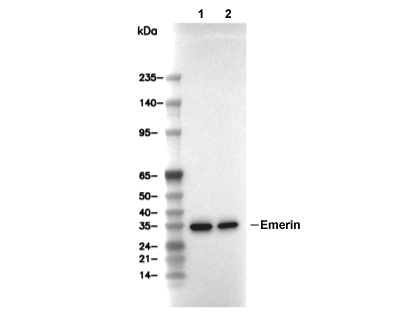 Lane 1: HeLa, Lane 2: HEK-293