
|
How to Cite 1. For In-Text Citation (Materials & Methods): 2. For Key Resources Table: |
||
|
Toll Free: (877) 796-6397 -- USA and Canada only -- |
Fax: +1-832-582-8590 Orders: +1-832-582-8158 |
Tech Support: +1-832-582-8158 Ext:3 Please provide your Order Number in the email. We strive to reply to |
Biological Description
| Specificity | DAB2 Antibody [K17C17] detects endogenous levels of total DAB2 protein. |
|---|---|
| Background | Disabled homolog 2 (DAB2/DOC‑2) is a multimodular clathrin‑associated adaptor that localizes primarily to the plasma membrane–proximal endocytic machinery and vesicular compartments, where it links selected cargo receptors and signaling proteins to clathrin‑mediated endocytosis and to signaling pathways that control cell positioning, epithelial–mesenchymal transition, and immune and tumor cell behavior. The protein contains an N‑terminal phosphotyrosine‑binding domain that recognizes NPXY motifs and interfaces with components of Wnt and other signaling complexes, a central region with multiple binding motifs for clathrin, phosphatidylinositol 4,5‑bisphosphate, and EH‑domain–containing endocytic accessory proteins, and a C‑terminal proline‑rich segment that engages SH3‑domain adaptors such as GRB2 and additional scaffolds, creating a versatile platform for assembling cargo–coat–signaling complexes. As a clathrin‑associated sorting protein, DAB2 binds simultaneously to PtdIns(4,5)P2 at the inner leaflet of the plasma membrane, to clathrin, and to NPXY‑bearing receptors including LDL receptor, integrin β1, megalin/LRP2, CFTR, and TGF‑β receptors, recruiting these cargos into clathrin‑coated pits and controlling their internalization, trafficking to early or late endosomes, and recycling or degradation. These endocytic functions extend into regulation of multiple receptor‑mediated signaling pathways: in TGF‑β signaling, DAB2 supports receptor endocytosis and facilitates phosphorylation and activation of SMAD2 and TGF‑β‑activated kinase 1, promoting JNK activation and fibronectin synthesis; in Wnt pathways, DAB2 stabilizes the β‑catenin destruction complex by associating with axin and sequesters LRP6 for clathrin‑mediated internalization, thereby inhibiting canonical Wnt/β‑catenin signaling while favoring non‑canonical branches. DAB2 also modulates growth factor and Ras signaling by binding GRB2 and competing with SOS1, which reduces GRB2–SOS coupling and attenuates ERK activation, and by interacting with SRC in a way that prevents its activating phosphorylation, thereby dampening SRC‑dependent pathways and influencing androgen receptor signaling where competition for SRC binding alters AR output. In immune regulation, DAB2 acts as a negative regulator of TLR4 endocytosis and signaling and participates in CSF‑1–dependent macrophage pathways, shaping innate immune responses, macrophage adhesion and spreading, and broader inflammatory signaling circuits. |
Usage Information
| Application | WB, IP, IHC | Dilution |
|
||||||
|---|---|---|---|---|---|---|---|---|---|
| Reactivity | Mouse, Rat, Human | ||||||||
| Source | Rabbit Monoclonal Antibody | MW | 82 kDa | ||||||
| Storage Buffer | PBS, pH 7.2+50% Glycerol+0.05% BSA+0.01% NaN3 | Storage (from the date of receipt) |
-20°C (avoid freeze-thaw cycles), 2 years | ||||||
References
|
Application Data
WB
Validated by Selleck
-
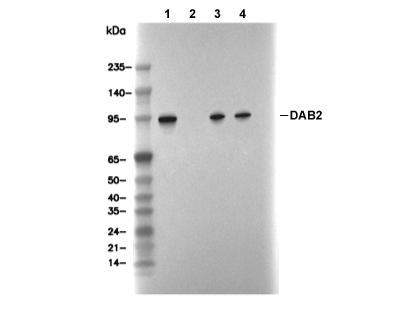 Lane 1: HeLa, Lane 2: HeLa (KO DAB2), Lane 3: Caco-2, Lane 4: PC-3