
|
How to Cite 1. For In-Text Citation (Materials & Methods): 2. For Key Resources Table: |
||
|
Toll Free: (877) 796-6397 -- USA and Canada only -- |
Fax: +1-832-582-8590 Orders: +1-832-582-8158 |
Tech Support: +1-832-582-8158 Ext:3 Please provide your Order Number in the email. We strive to reply to |
Biological Description
| Specificity | CYP1B1 Antibody [C13E23] detects endogenous levels of total CYP1B1 protein. |
|---|---|
| Background | CYP1B1 belongs to the cytochrome P450 1 family of monooxygenases primarily responsible for phase I metabolism of xenobiotics and endogenous substrates in extrahepatic tissues. The enzyme adopts a canonical P450 fold with a heme-binding pocket flanked by flexible substrate access channels that accommodate planar polycyclic aromatic hydrocarbons, estradiol, and retinoids, enabling regioselective hydroxylation through iron-oxo species generated via NADPH-cytochrome P450 reductase interactions. Under basal conditions, CYP1B1 catalyzes 4-hydroxylation of estradiol to yield genotoxic catechol estrogens that redox-cycle with NAD(P)H:quinone oxidoreductase 1 to produce reactive oxygen species, while polycyclic aromatic hydrocarbon epoxidation forms diol-epoxides that covalently adduct DNA at guanine residues, activating the ATR/ATM-p53 checkpoint to induce G1 arrest or apoptosis. Aryl hydrocarbon receptor translocates to the nucleus upon ligand binding, heterodimerizes with ARNT, and recruits Pol II to xenobiotic response elements in the CYP1B1 promoter, amplifying transcription in response to smoking-related toxins or dietary indoles. This induction sustains redox imbalance by depleting glutathione through quinone metabolites, intersecting with Wnt/β-catenin signaling where CYP1B1-derived 4-hydroxyestrogens stabilize nuclear β-catenin to drive cyclin D1 expression and epithelial-mesenchymal transition. In ocular anterior segments and hormone-responsive epithelia, CYP1B1 directs retinoid flux toward all-trans-retinoic acid degradation, patterning trabecular meshwork development and mammary gland branching morphogenesis. Extrahepatic predominance in melanoma, ovarian, and prostate tumors correlates with upregulated AhR activity, where CYP1B1 fuels intratumoral estrogen biosynthesis and procarcinogen activation, while germline variants impair anterior chamber angle closure leading to primary congenital glaucoma. |
Usage Information
| Application | WB, IHC | Dilution |
|
||||
|---|---|---|---|---|---|---|---|
| Reactivity | Human, Mouse, Rat | ||||||
| Source | Rabbit Monoclonal Antibody | MW | 61 kDa | ||||
| Storage Buffer | PBS, pH 7.2+50% Glycerol+0.05% BSA+0.01% NaN3 | Storage (from the date of receipt) |
-20°C (avoid freeze-thaw cycles), 2 years | ||||
References
|
Application Data
WB
Validated by Selleck
-
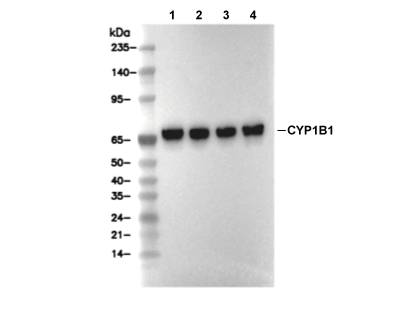 Lane 1: Rat heart, Lane 2: Rat liver, Lane 3: Rat spleen, Lane 4: Rat kidney