
|
How to Cite 1. For In-Text Citation (Materials & Methods): 2. For Key Resources Table: |
||
|
Toll Free: (877) 796-6397 -- USA and Canada only -- |
Fax: +1-832-582-8590 Orders: +1-832-582-8158 |
Tech Support: +1-832-582-8158 Ext:3 Please provide your Order Number in the email. We strive to reply to |
Biological Description
| Specificity | CRMP2 Antibody [K16M14] detects endogenous levels of total CRMP2 protein. |
|---|---|
| Background | CRMP2 (collapsin response mediator protein‑2, also known as DPYSL2) is a cytosolic phosphoprotein of the CRMP family that is highly enriched in the developing and adult nervous system and functions as a multifunctional adaptor that links extracellular guidance and neurotrophic cues to intracellular cytoskeletal remodeling, vesicle trafficking, and channel regulation. The protein forms homo‑ and hetero‑tetramers with other CRMPs and contains an N‑terminal globular domain with binding surfaces for tubulin and regulatory enzymes and a C‑terminal flexible tail that carries multiple phosphorylation motifs for kinases such as Cdk5 and GSK3β, oxidation‑sensitive cysteines, and other post‑translational modification sites that tune its activity and subcellular localization. CRMP2 associates with tubulin heterodimers and promotes microtubule polymerization and stabilization, and this activity supports axon specification, elongation, and branching, the multipolar‑to‑bipolar transition of migrating neurons, and the polarized delivery of cargoes along axons, while simultaneous interactions with kinesin‑1, dynein, and endocytic machinery link CRMP2 to axonal transport, protein endocytosis, and recycling of membrane receptors and channels. The protein also participates in presynaptic and postsynaptic organization by regulating vesicle trafficking and synaptic assembly and by controlling the surface density and cycling of voltage‑gated calcium and sodium channels, which positions CRMP2 as a modulator of neuronal excitability and neurotransmitter release in addition to its structural roles in neurite architecture. CRMP2 activity is strongly governed by hierarchical phosphorylation and other modifications: Cdk5‑primed and GSK3β‑mediated phosphorylation at defined C‑terminal residues weakens binding to tubulin and motor proteins and shifts CRMP2 from a growth‑promoting to a growth‑inhibiting state, while dephosphorylation restores interaction with the cytoskeleton and transport complexes, integrating upstream signals from semaphorin–plexin/neuropilin pathways, neurotrophins, and other regulators into precise changes in neurite outgrowth, branching, and guidance. In the mature brain CRMP2 continues to influence synaptic stability and plasticity through effects on microtubule dynamics within dendrites and axon terminals and through regulation of vesicle cycling and receptor trafficking, and mapping of the CRMP2 interactome reveals connections to proteins that orchestrate actin remodeling, endocytosis, and presynaptic release, extending its impact beyond classical axon guidance. Dysregulated CRMP2 expression, phosphorylation, truncation, or mislocalization associates with a wide spectrum of neurological and psychiatric conditions, including Alzheimer’s disease, temporal lobe epilepsy, neuropathic pain, and schizophrenia, where hyperphosphorylated CRMP2 accumulates in neurofibrillary tangles together with tau and SRA1/WAVE1 complexes and correlates with synaptic and structural deficits, and where altered channel trafficking and cytoskeletal control contribute to aberrant excitability and network function. |
Usage Information
| Application | WB, IP, IHC, IF, FCM | Dilution |
|
||||||||||
|---|---|---|---|---|---|---|---|---|---|---|---|---|---|
| Reactivity | Human, Mouse, Rat | ||||||||||||
| Source | Rabbit Monoclonal Antibody | MW | 29 kDa | ||||||||||
| Storage Buffer | PBS, pH 7.2+50% Glycerol+0.05% BSA+0.01% NaN3 | Storage (from the date of receipt) |
-20°C (avoid freeze-thaw cycles), 2 years | ||||||||||
References
|
Application Data
WB
Validated by Selleck
-
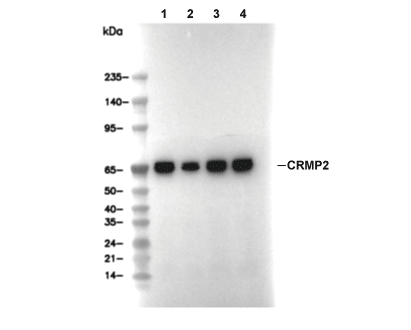 Lane 1: SH-SY5Y, Lane 2: Hela, Lane 3: NIH/3T3, Lane 4: C6