
|
How to Cite 1. For In-Text Citation (Materials & Methods): 2. For Key Resources Table: |
||
|
Toll Free: (877) 796-6397 -- USA and Canada only -- |
Fax: +1-832-582-8590 Orders: +1-832-582-8158 |
Tech Support: +1-832-582-8158 Ext:3 Please provide your Order Number in the email. We strive to reply to |
Biological Description
| Specificity | CRBN Antibody [M9N10] detects endogenous levels of total CRBN protein. |
|---|---|
| Background | Cereblon (CRBN) functions as the substrate receptor within the Cullin-RING E3 ubiquitin ligase 4 (CRL4^CRBN^) complex, which comprises DDB1, CUL4, RBX1, and CRBN, and mediates ubiquitination and proteasomal degradation of target proteins to regulate protein homeostasis, limb development, neuronal function, and immune signaling. CRBN adopts a tripartite architecture consisting of an N-terminal Lon protease-like domain, a central helical bundle domain mediating DDB1 interaction, and a C-terminal domain containing a pseudouridine synthase and archaeosine transglycosylase (PUA) fold that harbors both the substrate recognition interface and a conserved zinc-binding site coordinated by cysteine residues. The protein serves as a DCAF (DDB1-CUL4 associated factor) substrate receptor, positioning bound substrates within the ubiquitination zone generated by rotational mobility of the CUL4 ligase arm around DDB1, establishing spatial dimensions permitting promiscuous lysine targeting on proteins that enter this catalytic volume. CRBN recognizes endogenous substrates including the homeobox transcription factor MEIS2 through its C-terminal PUA domain, mediating their ubiquitination and degradation to control developmental gene expression programs and cellular differentiation. Thalidomide and its derivatives lenalidomide and pomalidomide bind a hydrophobic pocket within the CRBN C-terminal domain with dissociation constants ranging from approximately 150 to 250 nanomolar, occupying the canonical substrate recognition interface through glutarimide moiety interactions with His380 and Trp382 and establishing extensive van der Waals contacts with Trp382, Trp388, Trp402, and Phe404. Immunomodulatory drug (IMiD) binding to CRBN produces dual opposing effects—blocking recruitment and degradation of endogenous substrates like MEIS2 while simultaneously creating novel recognition interfaces that recruit neosubstrates including the Ikaros family transcription factors IKZF1 and IKZF3 for ubiquitination and degradation, functioning as molecular glue degraders that reprogram CRL4^CRBN^ substrate specificity. The solvent-exposed phthalimide C4 aniline functionality present in lenalidomide and pomalidomide but absent in thalidomide contributes directly to neosubstrate recruitment, with modifications at this position modulating degradation efficiency through altered protein-protein interaction surfaces formed between CRBN, bound IMiD, and target proteins containing glycine-loop (G-loop) recognition motifs. CRBN autoubiquitination occurs at unstructured N-terminal lysine residues K39 and K43, with this modification subject to inhibition by the COP9 signalosome (CSN), and IMiD binding does not prevent CRBN autoubiquitination, maintaining ligase activity while redirecting substrate specificity. The protein regulates large-conductance calcium-activated potassium (BK) channels by controlling their ubiquitination status, thereby modulating channel assembly, neuronal surface expression, and presynaptic glutamate release, which governs cognitive functions including memory and learning. CRBN participates in Toll-like receptor 4 (TLR4) signaling through interaction with TRAF6 and ECSIT, inhibiting ECSIT ubiquitination and suppressing inflammatory pathway activation. Loss-of-function mutations in CRBN, including the nonsense mutation R419X causing premature truncation after residue 419, associate with autosomal recessive nonsyndromic intellectual disability, likely through disrupted regulation of BK channel-mediated neuronal excitability and altered substrate recognition due to loss of C-terminal structural elements bordering the substrate-binding pocket. CRBN expression determines sensitivity to IMiD-based therapies in multiple myeloma, with CRBN loss representing a common resistance mechanism that abrogates lenalidomide and pomalidomide efficacy by eliminating the substrate receptor required for IKZF1 and IKZF3 degradation. The protein exhibits ubiquitous tissue expression with particularly high levels in testis, brain, kidney, and muscle, and exhibits cytoplasmic localization where it assembles with CRL4 complex components to execute spatially regulated ubiquitination events. |
Usage Information
| Application | WB, IP, FCM | Dilution |
|
||||||
|---|---|---|---|---|---|---|---|---|---|
| Reactivity | Human, Mouse | ||||||||
| Source | Rabbit Monoclonal Antibody | MW | 50 kDa | ||||||
| Storage Buffer | PBS, pH 7.2+50% Glycerol+0.05% BSA+0.01% NaN3 | Storage (from the date of receipt) |
-20°C (avoid freeze-thaw cycles), 2 years | ||||||
References
|
Application Data
WB
Validated by Selleck
-
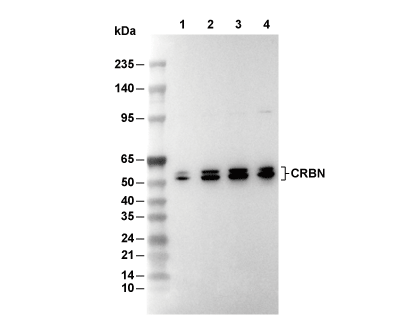 Lane 1: MOLT-4, Lane 2: Hela, Lane 3: NIH/3T3, Lane 4: C6