
|
How to Cite 1. For In-Text Citation (Materials & Methods): 2. For Key Resources Table: |
||
|
Toll Free: (877) 796-6397 -- USA and Canada only -- |
Fax: +1-832-582-8590 Orders: +1-832-582-8158 |
Tech Support: +1-832-582-8158 Ext:3 Please provide your Order Number in the email. We strive to reply to |
Biological Description
| Specificity | CLCN3 Antibody [E24D24] detects endogenous levels of total CLCN3 protein. |
|---|---|
| Background | CLCN3 (chloride voltage‑gated channel 3) is a broadly expressed ClC‑family 2Cl⁻/H⁺ exchanger that localizes to plasma membranes and intracellular vesicles, where it mediates electrogenic exchange of chloride ions for protons and contributes to acidification of endosomes and synaptic vesicles, regulation of vesicle trafficking and exocytosis, and control of neuronal excitability and smooth muscle activation. The protein is a multi‑pass membrane transporter with a ClC core domain that forms the anion/proton transport pathway and two cytosolic C‑terminal cystathionine‑β‑synthase (CBS) domains that act as regulatory modules; conserved “gating glutamate” residues within the ClC domain define CLCN3 as a proton‑coupled antiporter rather than a simple chloride channel, and the transporter functions as a homodimer, with each subunit containing an independent Cl⁻/H⁺ transport pathway. CLCN3 expression is particularly high in neuroectoderm‑derived tissues and concentrates in hippocampus, olfactory cortex, and olfactory bulb, consistent with its role in synaptic vesicle lumen acidification and transmitter loading at GABAergic terminals, where it complements vesicular H⁺‑ATPases to set the electrochemical environment required for efficient accumulation of neurotransmitters and for proper short‑term synaptic plasticity. The exchanger participates in endosomal acidification and vesicle trafficking more generally, influencing receptor recycling and degradation, and is also required for lysophosphatidic acid–activated chloride currents and fibroblast‑to‑myofibroblast differentiation, implicating CLCN3 in extracellular matrix remodeling and neointima formation during vascular injury, with roles in smooth muscle cell activation and vascular proliferative responses. Regulatory control of CLCN3 involves Ca²⁺/calmodulin‑dependent protein kinase II (CaMKII), which modulates channel activity and surface expression in glioma cells, providing a mechanism by which Ca²⁺‑dependent signaling pathways tune CLCN3‑mediated chloride fluxes and thereby affect cell volume regulation, migration, and invasive behavior in malignant glia. Identification of CLCN3 together with CLCN5 as mediators of sphingosine‑1‑phosphate–induced excitatory chloride currents in sensory neurons links the transporter to neuromodulatory lipid signaling and sensory processing, expanding its functional relevance beyond classical vesicular acidification to acute regulation of membrane potential and nociceptive signaling. |
Usage Information
| Application | WB, IP, IF | Dilution |
|
||||||
|---|---|---|---|---|---|---|---|---|---|
| Reactivity | Human, Mouse, Rat | ||||||||
| Source | Rabbit Monoclonal Antibody | MW | 91 kDa | ||||||
| Storage Buffer | PBS, pH 7.2+50% Glycerol+0.05% BSA+0.01% NaN3 | Storage (from the date of receipt) |
-20°C (avoid freeze-thaw cycles), 2 years | ||||||
References
|
Application Data
WB
Validated by Selleck
-
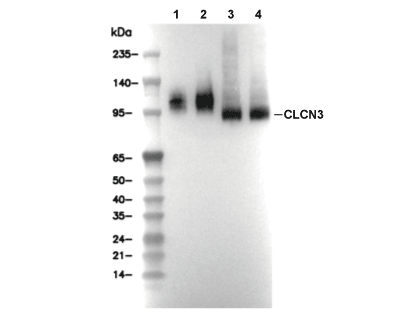 Lane 1: DLD-1, Lane 2: Jurkat, Lane 3: Mouse brain, Lane 4: Rat brain