
|
How to Cite 1. For In-Text Citation (Materials & Methods): 2. For Key Resources Table: |
||
|
Toll Free: (877) 796-6397 -- USA and Canada only -- |
Fax: +1-832-582-8590 Orders: +1-832-582-8158 |
Tech Support: +1-832-582-8158 Ext:3 Please provide your Order Number in the email. We strive to reply to |
Biological Description
| Specificity | Cellubrevin Antibody [C19C14] detects endogenous levels of total Cellubrevin protein. |
|---|---|
| Background | Cellubrevin, also designated VAMP-3 (vesicle-associated membrane protein-3), represents a ubiquitously expressed vesicular SNARE (v-SNARE) protein that functions in constitutive membrane trafficking pathways distinct from the neuron-specific synaptobrevins VAMP-1 and VAMP-2 despite sharing substantial sequence homology and biochemical properties with these regulated exocytotic v-SNAREs. Cellubrevin localizes to recycling endosomes, early endosomes, and the basolateral plasma membrane where it colocalizes with the epithelial-specific adaptor complex AP-1B, positioning it at critical membrane fusion sites within endocytic recycling circuits. The protein contains a conserved SNARE motif that mediates interaction with cognate target SNAREs (t-SNAREs), forming stable four-helix bundle complexes essential for membrane fusion, and interacts preferentially with syntaxin 4 and SNAP-23 to generate a functional core complex that drives fusion of endosome-derived vesicles with the basolateral plasma membrane in polarized epithelial cells. Cellubrevin cooperates with AP-1B to mediate basolateral sorting and delivery of transmembrane cargo proteins, including transferrin receptor and low-density lipoprotein receptor from recycling endosomes to the basolateral surface, with cleavage of cellubrevin by tetanus neurotoxin disrupting AP-1B localization and causing misssorting of AP-1B-dependent cargo. The protein executes pivotal functions in receptor-mediated endocytosis, particularly governing fibrinogen uptake and storage in platelets, where cargo traffics sequentially through Rab4-positive early endosomes, Rab11-positive recycling endosomes, and von Willebrand factor-positive compartments before reaching storage sites or returning to the plasma membrane. Loss of cellubrevin function selectively impairs fibrinogen uptake while exerting minimal effects on fluid-phase endocytosis, demonstrating specificity for receptor-mediated cargo internalization pathways. Cellubrevin-mediated membrane fusion events regulate endosomal maturation and cargo progression through distinct Rab GTPase-defined compartments, with the absence of cellubrevin preventing normal colocalization of internalized cargo with Rab4, Rab11, and von Willebrand factor markers, thereby disrupting temporal progression through endocytic compartments. The protein participates in the trafficking of integrins, including αIIbβ3 and αvβ3, as well as purinergic receptors P2Y1 and P2Y12, influencing platelet spreading on fibrinogen and fibronectin substrates and modulating clot retraction kinetics. Cellubrevin function extends to regulation of receptor signaling dynamics, affecting Janus kinase 2 phosphorylation rates downstream of thrombopoietin receptor activation, linking endocytic trafficking machinery to signal transduction cascades. |
Usage Information
| Application | WB, IHC, IF, FCM | Dilution |
|
||||||||
|---|---|---|---|---|---|---|---|---|---|---|---|
| Reactivity | Human, Mouse, Rat | ||||||||||
| Source | Rabbit Monoclonal Antibody | MW | 11 kDa | ||||||||
| Storage Buffer | PBS, pH 7.2+50% Glycerol+0.05% BSA+0.01% NaN3 | Storage (from the date of receipt) |
-20°C (avoid freeze-thaw cycles), 2 years | ||||||||
References
|
Application Data
WB
Validated by Selleck
-
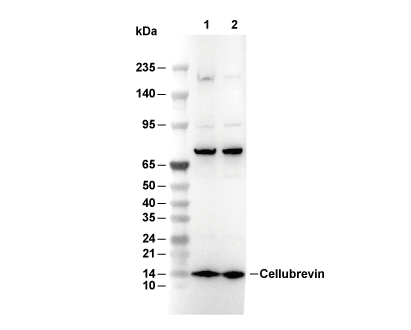 Lane 1: 293T, Lane 2: A549