
|
How to Cite 1. For In-Text Citation (Materials & Methods): 2. For Key Resources Table: |
||
|
Toll Free: (877) 796-6397 -- USA and Canada only -- |
Fax: +1-832-582-8590 Orders: +1-832-582-8158 |
Tech Support: +1-832-582-8158 Ext:3 Please provide your Order Number in the email. We strive to reply to |
Biological Description
| Specificity | CD105 Antibody [F19M3] detects endogenous levels of total CD105 protein. |
|---|---|
| Background | Endoglin (CD105) is a homodimeric transmembrane glycoprotein of the TGF‑β receptor complex that is highly enriched on proliferating vascular endothelial cells and acts as an accessory receptor that modulates TGF‑β family signaling to control angiogenesis, vascular remodeling, and endothelial behavior. The extracellular region contains an orphan receptor–like N‑terminal domain followed by a zona pellucida–like region and a short juxtamembrane segment that together provide binding sites for TGF‑β1 and TGF‑β3 and for association with signaling receptors ALK1 and ALK5, while the short cytoplasmic tail carries conserved serine/threonine residues and a PDZ‑binding motif that connect CD105 to intracellular kinases and scaffold proteins. By associating with type I and type II TGF‑β receptors, CD105 shifts signaling toward ALK1/Smad1/5 pathways that promote endothelial proliferation, migration, and survival and attenuates ALK5/Smad2/3 signaling that would otherwise favor growth arrest and differentiation, thereby biasing TGF‑β responses toward a pro‑angiogenic profile in activated endothelium. Hypoxia and pro‑angiogenic cues upregulate CD105 expression in endothelial cells within sprouting and remodeling vessels, and high CD105 levels correlate with strong microvessel density in tumor vasculature, where CD105‑dependent modulation of TGF‑β signaling supports neovascularization and maintenance of structurally and functionally abnormal tumor blood vessels. The receptor can be shed into the circulation as soluble CD105, which retains ligand‑binding capacity and reflects endothelial activation status in various cancers and vascular diseases. Germline loss‑of‑function mutations in the ENG gene cause hereditary hemorrhagic telangiectasia type 1, characterized by fragile, dilated vessels and arteriovenous malformations, consistent with a requirement for CD105 in proper vessel wall development and stabilization during angiogenesis. CD105‑marked microvessel density serves as a sensitive measure of tumor angiogenesis and an independent prognostic factor, as higher CD105‑positive vessel counts associate with increased metastatic risk and shorter survival in multiple cancer types. |
Usage Information
| Application | WB, IP, IHC, IF, FCM | Dilution |
|
||||||||||
|---|---|---|---|---|---|---|---|---|---|---|---|---|---|
| Reactivity | Mouse | ||||||||||||
| Source | Rabbit Monoclonal Antibody | MW | 70 kDa | ||||||||||
| Storage Buffer | PBS, pH 7.2+50% Glycerol+0.05% BSA+0.01% NaN3 | Storage (from the date of receipt) |
-20°C (avoid freeze-thaw cycles), 2 years | ||||||||||
References
|
Application Data
WB
Validated by Selleck
-
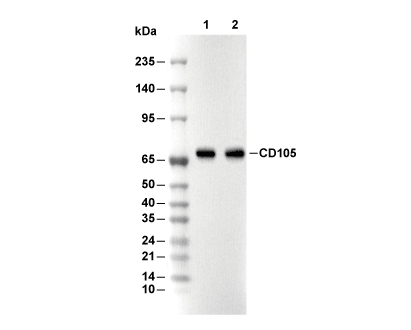 Lane 1: bEND.3, Lane 2: Mouse lung