
|
How to Cite 1. For In-Text Citation (Materials & Methods): 2. For Key Resources Table: |
||
|
Toll Free: (877) 796-6397 -- USA and Canada only -- |
Fax: +1-832-582-8590 Orders: +1-832-582-8158 |
Tech Support: +1-832-582-8158 Ext:3 Please provide your Order Number in the email. We strive to reply to |
Biological Description
| Specificity | Caspase9 Antibody [A3K12] detects endogenous levels of total Caspase9 protein. |
|---|---|
| Background | Caspase-9 is an initiator caspase central to the intrinsic apoptosis pathway, acting at the apex of the mitochondrial death signaling cascade. Upon cytochrome c release from mitochondria, caspase-9 assembles into the Apaf-1 apoptosome. This process involves induced proximity oligomerization via Apaf-1 CARD domain interactions, leading to autocatalytic cleavage at Asp315 and formation of an active p35/p12 heterodimer. A secondary cleavage at Asp330 yields a p37 fragment, further amplifying effector caspase activation. The apoptosome-bound caspase-9 demonstrates over 100-fold enhanced activity due to allosteric stabilization of its active conformation, maintained by Apaf-1 even without continued dATP presence after assembly. This holoenzyme efficiently activates caspase-3 and caspase-7, initiating the executioner phase, which results in PARP cleavage, DNA fragmentation, and cytoskeletal collapse. Physiological inhibition occurs through Xiap, which binds the active site and BIR2 domain of processed caspase-9; however, caspase-3 feedback cleavage of Xiap relieves this inhibition, ensuring irreversible apoptosis commitment. Alternative splicing produces the dominant-negative caspase-9S isoform, which lacks catalytic activity and competes for apoptosome docking. Caspase-9 is essential for developmental sculpting, DNA damage surveillance, and stress-induced clearance in neurons and lymphocytes. It serves as the canonical marker for intrinsic apoptosis in research assays using fluorogenic substrates or dominant-negative mutants in flow cytometry. Caspase-9 deficiency leads to severe lymphoproliferation and autoimmunity, while APAF-1 methylation in cancer silences the pathway. |
Usage Information
| Application | WB | Dilution |
|
||
|---|---|---|---|---|---|
| Reactivity | Human, Mouse, Rat, Hamster, Monkey | ||||
| Source | Mouse Monoclonal Antibody | MW | 35-51 kDa | ||
| Storage Buffer | PBS, pH 7.2+50% Glycerol+0.05% BSA+0.01% NaN3 | Storage (from the date of receipt) |
-20°C (avoid freeze-thaw cycles), 2 years | ||
References
|
Application Data
WB
Validated by Selleck
-
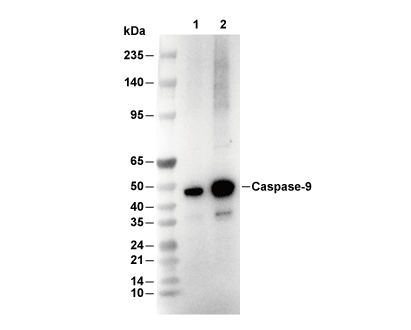 Lane 1: Jurkat, Lane 2: Jurkat (staurosporine treated)