
|
How to Cite 1. For In-Text Citation (Materials & Methods): 2. For Key Resources Table: |
||
|
Toll Free: (877) 796-6397 -- USA and Canada only -- |
Fax: +1-832-582-8590 Orders: +1-832-582-8158 |
Tech Support: +1-832-582-8158 Ext:3 Please provide your Order Number in the email. We strive to reply to |
Technical Data
| Formula | C15H22FN3O6 |
||||||||||
| Molecular Weight | 359.35 | CAS No. | 154361-50-9 | ||||||||
| Solubility (25°C)* | In vitro | DMSO | 72 mg/mL (200.36 mM) | ||||||||
| Ethanol | 72 mg/mL (200.36 mM) | ||||||||||
| Water | 18 mg/mL (50.09 mM) | ||||||||||
| In vivo (Add solvents to the product individually and in order) |
|
||||||||||
|
* <1 mg/ml means slightly soluble or insoluble. * Please note that Selleck tests the solubility of all compounds in-house, and the actual solubility may differ slightly from published values. This is normal and is due to slight batch-to-batch variations. * Room temperature shipping (Stability testing shows this product can be shipped without any cooling measures.) |
|||||||||||
Preparing Stock Solutions
Biological Activity
| Description | Capecitabine is a tumor-selective fluoropyrimidine carbamate, which achieves higher intratumoral 5-FU level with lower toxicity than 5-FU. Capecitabine treatment of HCT-15 cells causes condensation of DNA and induces apoptosis. | |
|---|---|---|
| Targets |
|
|
| In vitro | Both LS174T WT and LS174T-c2 cells show significantly greater sensitivity to Capecitabine when cultivated in the same plates as HepG2 hepatoma with IC50 values of 890 and 630 μM in LS174T WT alone and cultivated with HepG2, respectively. In addition, for the LS174T-C2 subline, the IC50 falls from 330 ± 4 down to 89 ± 6 μm when cultivated in the same plates as hepatoma cells. Furthermore, this compound induces apoptosis in a Fas-dependent manner, and shows a 7-fold higher cytotoxicity and markedly stronger apoptotic potential in thymidine phosphorylase (TP)-transfected LS174T-c2 cells. | |
| In vivo | In the human cancer xenograft models studied, Capecitabine is more effective in a wider dose range and has a broader spectrum of antitumor activity than 5-FU, UFT or its intermediate metabolite 5'-DFUR, which can be correlated with tumor dThdPase levels. This compound inhibits tumor growth and metastatic recurrence after resection of human hepatocellular carcinoma (HCC) in highly metastatic nude mice model which is attributed to the high expression of platelet-derived endothelial cell growth factor in tumors. | |
| Features | A tumor-selective fluoropyrimidine carbamate. |
Protocol (from reference)
| Cell Assay:[1] |
|
|---|---|
| Animal Study:[2] |
|
References
|
Customer Product Validation
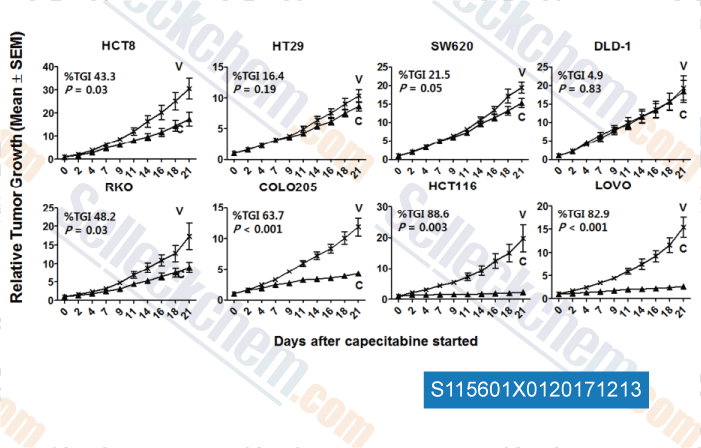
-
, , Cancer Res, 2017, 77(24):7120-7130
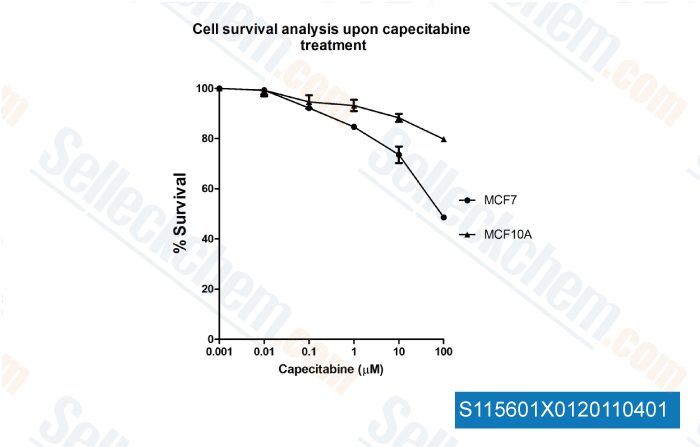
-
, , Dr. Helen Sadik of Johns Hopkins University
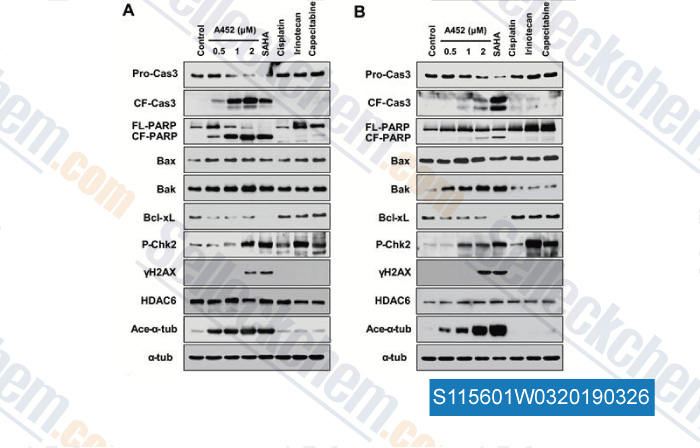
-
Data from [ , , Carcinogenesis, 2018, 39(1):72-83 ]
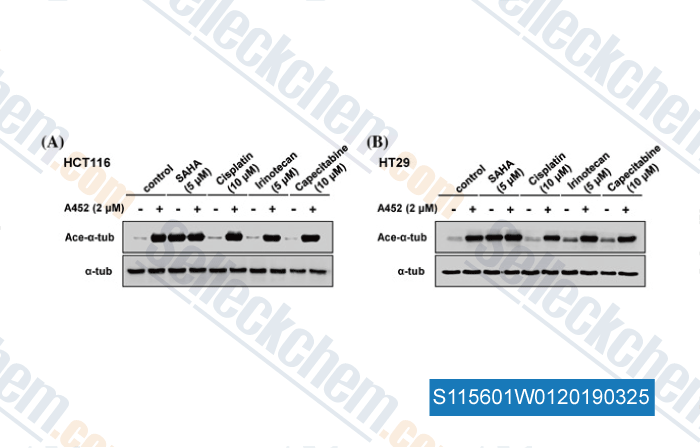
-
Data from [ , , Mol Carcinog, 2018, 57(10):1383-1395 ]
Selleck's Capecitabine Has Been Cited by 33 Publications
| Fisetin and/or capecitabine causes changes in apoptosis pathways in capecitabine-resistant colorectal cancer cell lines [ Naunyn-Schmiedebergs Archives of Pharmacology, May 15, 2024, 7913-7926] | PubMed: 30279143 |
| Anti-cancer drug sensitivity testing and preclinical evaluation of the anti-cancer potential of WEE1 inhibitor in triple-negative breast cancer patient-derived organoids and xenograft models [ Breast Cancer Research, June 23, 2025, 113] | PubMed: 40551232 |
| A potential novel therapy for FGFR1-amplified pancreatic cancer with bone metastasis, screened by next-generation sequencing and a patient-derived xenograft model [ Oncology Letters, December 28, 2018, 2303-2307] | |
| [18F]fluorothymidine PET Informs the Synergistic Efficacy of Capecitabine and Trifluridine/Tipiracil in Colon Cancer [ Cancer Research, December 15, 2017, 7120-7130] | |
| Individualized drug screening based on next generation sequencing and patient derived xenograft model for pancreatic cancer with bone metastasis [ Molecular Medicine Reports, August 10, 2017, 4784-4790] | PubMed: 28849200 |
| A pancreatic cancer organoid biobank links multi-omics signatures to therapeutic response and clinical evaluation of statin combination therapy [ Cell Stem Cell, 2025, S1934-5909(25)00265-6] | PubMed: 40812300 |
| Zinc finger protein 831 promotes apoptosis and enhances chemosensitivity in breast cancer by acting as a novel transcriptional repressor targeting the STAT3/Bcl2 signaling pathway [ Genes Dis, 2024, 11(1):430-448] | PubMed: 37588209 |
| Patient-derived rhabdomyosarcoma cells recapitulate the genetic and transcriptomic landscapes of primary tumors [ iScience, 2024, 27(10):110862] | PubMed: 39319271 |
| Fisetin and/or capecitabine causes changes in apoptosis pathways in capecitabine-resistant colorectal cancer cell lines [ Naunyn Schmiedebergs Arch Pharmacol, 2024, 397(10):7913-7926] | PubMed: 38748229 |
| Fisetin and/or capecitabine causes changes in apoptosis pathways in capecitabine-resistant colorectal cancer cell lines [ Naunyn Schmiedebergs Arch Pharmacol, 2024, 10.1007/s00210-024-03145-0] | PubMed: 38748229 |
RETURN POLICY
Selleck Chemical’s Unconditional Return Policy ensures a smooth online shopping experience for our customers. If you are in any way unsatisfied with your purchase, you may return any item(s) within 7 days of receiving it. In the event of product quality issues, either protocol related or product related problems, you may return any item(s) within 365 days from the original purchase date. Please follow the instructions below when returning products.
SHIPPING AND STORAGE
Selleck products are transported at room temperature. If you receive the product at room temperature, please rest assured, the Selleck Quality Inspection Department has conducted experiments to verify that the normal temperature placement of one month will not affect the biological activity of powder products. After collecting, please store the product according to the requirements described in the datasheet. Most Selleck products are stable under the recommended conditions.
NOT FOR HUMAN, VETERINARY DIAGNOSTIC OR THERAPEUTIC USE.
- Capecitabine Mechanism of Action: Thymidylate Synthase Inhibition in Breast Cancer Cell Research
- Capecitabine Clinical Trials
- Capecitabine Working Concentration | Cell Culture | Treatment
- Capecitabine Solubility in DMSO
- Capecitabine Stock Solution
- Capecitabine Storage
- Capecitabine Stability
- Capecitabine Combination Database
- Capecitabine Molecular Weight
- Capecitabine SMILES
- Capecitabine CAS Number
- Capecitabine Chemical Structure (2D and 3D)
- Capecitabine IC50 for Cell-based and Cell-free Assays
- Capecitabine Sigma (PHR1405)? Try a better option.
- Capecitabine Cayman (10487)? Try a better option.
- Capecitabine APExBIO (A8647)? Try a better option.
- Capecitabine MedChemExpress (HY-B0016)? Try a better option.
- Capecitabine SDS|MSDS