
|
How to Cite 1. For In-Text Citation (Materials & Methods): 2. For Key Resources Table: |
||
|
Toll Free: (877) 796-6397 -- USA and Canada only -- |
Fax: +1-832-582-8590 Orders: +1-832-582-8158 |
Tech Support: +1-832-582-8158 Ext:3 Please provide your Order Number in the email. We strive to reply to |
Biological Description
| Specificity | CaMKK2 Antibody [P19A6] detects endogenous levels of total CaMKK2 protein. |
|---|---|
| Background | Calcium/calmodulin‑dependent protein kinase kinase 2 (CaMKK2) is a serine/threonine kinase of the CaMK family that acts as a key node linking Ca²⁺‑calmodulin signals to downstream metabolic and transcriptional pathways in multiple tissues. CaMKK2 contains a central kinase domain, an autoinhibitory segment, and a Ca²⁺/calmodulin‑binding region that together regulate its activation state, with a distinctive Pro/Arg/Gly‑rich insert following the ATP‑binding site that helps distinguish it from other CaMKK isoforms and influences its interaction landscape. Increases in cytoplasmic Ca²⁺ through voltage‑gated CaV1.2 channels, NMDA receptors, and certain hormone receptors elevate Ca²⁺/calmodulin levels, which bind CaMKK2, relieve autoinhibition, and promote autophosphorylation, thereby enabling CaMKK2 to phosphorylate several downstream kinases, most notably CaMKI at Thr177 and CaMKIV at Thr200, as well as AMPKα subunits in response to Ca²⁺ fluxes. Via these targets, CaMKK2 feeds into signaling networks that control neuronal excitability and gene expression related to synaptic plasticity and long‑term memory, while through AMPK activation it also modulates cellular energy homeostasis, adipocyte differentiation, and glucose metabolism. CaMKK2 is subject to multisite phosphorylation, including PKA‑dependent phosphorylation at Ser495 that blocks Ca²⁺/calmodulin binding and promotes 14‑3‑3–dependent sequestration, and modulation by CDK5/GSK3‑dependent phosphorylation at a serine‑rich node that tamps down basal activity, thereby integrating inputs from cAMP, cyclin‑dependent, and kinase‑phosphatase pathways into a finely tuned Ca²⁺/energy‑sensing switch. |
Usage Information
| Application | WB | Dilution |
|
||
|---|---|---|---|---|---|
| Reactivity | Human, Mouse, Rat | ||||
| Source | Rabbit Monoclonal Antibody | MW | 68 kDa, 70 kDa | ||
| Storage Buffer | PBS, pH 7.2+50% Glycerol+0.05% BSA+0.01% NaN3 | Storage (from the date of receipt) |
-20°C (avoid freeze-thaw cycles), 2 years | ||
References
|
Application Data
WB
Validated by Selleck
-
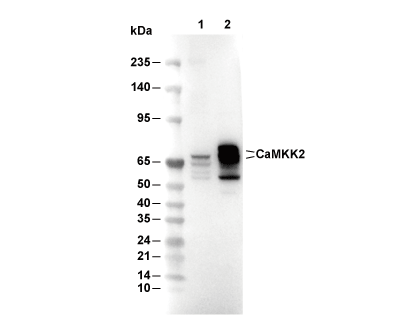 Lane 1: LNCaP, Lane 2: Mouse brain