
|
How to Cite 1. For In-Text Citation (Materials & Methods): 2. For Key Resources Table: |
||
|
Toll Free: (877) 796-6397 -- USA and Canada only -- |
Fax: +1-832-582-8590 Orders: +1-832-582-8158 |
Tech Support: +1-832-582-8158 Ext:3 Please provide your Order Number in the email. We strive to reply to |
Biological Description
| Specificity | ATP1B1 Antibody (Rabbit mAb) [N8L6] detects endogenous levels of total ATP1B1 protein. |
|---|---|
| Background | ATP1B1 encodes the beta-1 subunit of the Na+/K+-ATPase, a non-catalytic membrane glycoprotein that assembles with the catalytic alpha subunit to form the active ion pump responsible for maintaining the sodium and potassium gradients across the plasma membrane. Functional analysis of chimeric constructs shows that the beta subunit interacts with the alpha subunit through three separate regions, the ectodomain, the transmembrane segment, and the cytoplasmic domain, and that correct interactions at both the transmembrane and ectodomain regions are required to fold the complex properly and route it to the plasma membrane; beta-subunit constructs retaining only the transmembrane domain of a related beta isoform produce alpha-beta complexes that remain trapped in the endoplasmic reticulum, while others reach the surface but show reduced ion transport function, demonstrating that different regions of the beta subunit separately control folding, ER exit and functional competence of the assembled pump. The beta subunit further tunes the ion-binding properties of the completed pump: truncating the beta subunit's N-terminal region still permits cell-surface expression of functional sodium pumps, but these pumps show reduced apparent affinity for both potassium and sodium ions, and this functional change is traced not to a direct interaction of the truncated N-terminus with the alpha subunit but to a resulting conformational shift transmitted to another, functionally relevant region of the beta subunit. Beyond this structural and ion-transport role, the beta-1 subunit independently functions as a cell-adhesion molecule and signaling scaffold, and its expression is directly regulated by sonic hedgehog signaling in medulloblastoma, where knocking down beta-1 subunit expression reduces medulloblastoma cell proliferation and tumor-forming capacity, linking a developmental morphogen pathway to control of this ion-pump subunit's non-canonical, growth-promoting function in this brain tumor. Because loss of beta-1 subunit expression is separately associated with a poorly differentiated phenotype in carcinoma cells and with tumor-suppressive activity in other contexts, ATP1B1 sits at the intersection of ion homeostasis, epithelial cell polarity and tumor growth regulation, with the specific functional outcome of altered beta-1 expression depending on the tissue and signaling context involved. |
Usage Information
| Application | WB, IHC | Dilution |
|
||||
|---|---|---|---|---|---|---|---|
| Reactivity | Mouse, Rat, Human | ||||||
| Source | Rabbit Monoclonal Antibody | MW | 35 kDa | ||||
| Storage Buffer | PBS, pH 7.2+50% Glycerol+0.05% BSA+0.01% NaN3 | Storage (from the date of receipt) |
-20°C (avoid freeze-thaw cycles), 2 years | ||||
References
|
Application Data
WB
Validated by Selleck
-
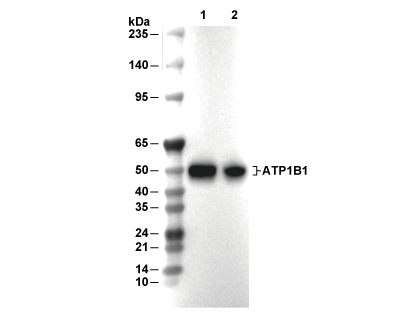 Lane 1: Mouse brain, Lane 2: Rat heart