
|
How to Cite 1. For In-Text Citation (Materials & Methods): 2. For Key Resources Table: |
||
|
Toll Free: (877) 796-6397 -- USA and Canada only -- |
Fax: +1-832-582-8590 Orders: +1-832-582-8158 |
Tech Support: +1-832-582-8158 Ext:3 Please provide your Order Number in the email. We strive to reply to |
Biological Description
| Specificity | α-Parvin Antibody [P1L24] detects endogenous levels of total α-Parvin protein. |
|---|---|
| Background | α-Parvin belongs to the parvin family of adaptor proteins within the IPP (ILK/PINCH/parvin) complex that bridges integrin extracellular matrix receptors to the actin cytoskeleton at focal adhesions. α-parvin organizes two calponin-homology domains that bind F-actin alongside a paxillin-binding CH2 subdomain and ankyrin repeats that engage ILK and PINCH for ternary complex assembly at integrin tails. Upon ECM engagement, ERK-mediated N-terminal serine phosphorylation dissociates α-parvin from TESK1 cofilin kinase, relieving inhibition to enable cofilin phosphorylation, LIMK1 activation, and F-actin stabilization at lamellipodia for directional motility. α-parvin simultaneously recruits CdGAP to hydrolyze Rac1-GTP, tempering lamellipodial expansion while promoting focal adhesion turnover through paxillin-LIMK signaling that balances protrusion with traction force generation. Interaction with α-actinin cross-links actin filaments to ILK pseudokinase activity, propagating FAK/Src cascades that phosphorylate paxillin for RIPLET-mediated ubiquitination and endocytic recycling of integrin clusters during migration. α-parvin coordinates epithelial sheet migration and myofibroblast contractility in wound healing, with ubiquitous expression adapting to mechanical cues via stiffness-dependent ILK conformational shifts. During mitosis, cyclin B1-CDK1 phosphorylation modulates α-parvin localization to the spindle, linking cytoskeletal reorganization to chromosome segregation fidelity. Dysregulation elevates α-parvin in invasive carcinomas, where hyperphosphorylation sustains Rac1 hyperactivation and matrix metalloproteinase secretion for basement membrane breaching. |
Usage Information
| Application | WB, IP, IF | Dilution |
|
||||||
|---|---|---|---|---|---|---|---|---|---|
| Reactivity | Human, Mouse, Rat, Monkey, Dog | ||||||||
| Source | Rabbit Monoclonal Antibody | MW | 50-80 kDa | ||||||
| Storage Buffer | PBS, pH 7.2+50% Glycerol+0.05% BSA+0.01% NaN3 | Storage (from the date of receipt) |
-20°C (avoid freeze-thaw cycles), 2 years | ||||||
References
|
Application Data
WB
Validated by Selleck
-
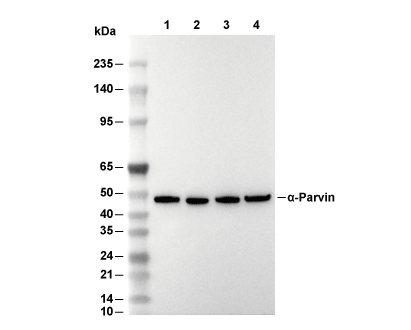 Lane 1: Hela, Lane 2: COS-7, Lane 3: NIH/3T3, Lane 4: C6