
|
How to Cite 1. For In-Text Citation (Materials & Methods): 2. For Key Resources Table: |
||
|
Toll Free: (877) 796-6397 -- USA and Canada only -- |
Fax: +1-832-582-8590 Orders: +1-832-582-8158 |
Tech Support: +1-832-582-8158 Ext:3 Please provide your Order Number in the email. We strive to reply to |
Technical Data
| Formula | C56H87NO16 |
||||||
| Molecular Weight | 1030.29 | CAS No. | 162635-04-3 | ||||
| Solubility (25°C)* | In vitro | DMSO | 100 mg/mL (97.06 mM) | ||||
| Ethanol | 100 mg/mL (97.06 mM) | ||||||
| Water | Insoluble | ||||||
| In vivo (Add solvents to the product individually and in order) |
|
||||||
|
* <1 mg/ml means slightly soluble or insoluble. * Please note that Selleck tests the solubility of all compounds in-house, and the actual solubility may differ slightly from published values. This is normal and is due to slight batch-to-batch variations. * Room temperature shipping (Stability testing shows this product can be shipped without any cooling measures.) |
|||||||
Preparing Stock Solutions
Biological Activity
| Description | Temsirolimus is a specific mTOR inhibitor with IC50 of 1.76 μM in a cell-free assay. Temsirolimus induces autophagy and apoptosis. | ||
|---|---|---|---|
| Targets |
|
||
| In vitro | In the absence of FKBP12, Temsirolimus potently inhibits mTOR kinase activity with IC50 of 1.76 μM, similar to that of rapamycin with IC50 of 1.74 μM. This compound treatment at nanomolar concentrations (10 nM to <5 μM) displays a modest and selective antiproliferative activity via FKBP12-dependent mechanism, but can completely inhibit the proliferation of a broad panel of tumor cells at low micromolar concentrations (5-15 μM), involving FKBP12-independent suppression of mTOR signaling. This chemical treatment at micromolar but not nanomolar concentrations (20 μM) causes a marked decline in global protein synthesis and disassembly of polyribosomes, accompanied by rapid increase in the phosphorylation of translation elongation factor eEF2 and the translation initiation factor eIF2A. It inhibits the phosphorylation of ribosomal protein S6, more potently in PTEN-positive DU145 cells than in PTEN-negative PC-3 cells, and inhibits cell growth and clonogenic survival of both cells in a concentration-dependent manner. This compound (100 ng/mL) potently inhibits proliferation and induces apoptosis in primary human lymphoblastic leukemia (ALL) cells. | ||
| In vivo | In the NOD/SCID xenograft models with human ALL, Temsirolimus treatment at 10 mg/kg/day produces a decrease in peripheral blood blasts and in splenomegaly Administration of this compound (20 mg/kg i.p. 5 days/week) significantly delays the growth of DAOY xenografts by 160% after 1 week and 240% after 2 weeks, compared with controls. Single high-dose of this chemical (100 mg/kg i.p) treatment induces 37% regression of tumor volume within 1 week. This compound treatment for 2 weeks also delays the growth of rapamycin-resistant U251 xenografts by 148%. Inhibition of mTOR by this agent improves performance on four different behavioral tasks and decreases aggregate formation in a mouse model of Huntington disease. Administration of this compound induces significant dose-dependent, antitumor responses against subcutaneous growth of 8226, OPM-2, and U266 xenografts with ED50 of 20 mg/kg and 2 mg/kg for 8226 and OPM-2, respectively, which are associated with inhibited proliferation and angiogenesis, induction of apoptosis, and reduction in tumor cell size. |
Protocol (from reference)
| Kinase Assay: |
|
|---|---|
| Cell Assay: |
|
| Animal Study: |
|
References
|
Customer Product Validation
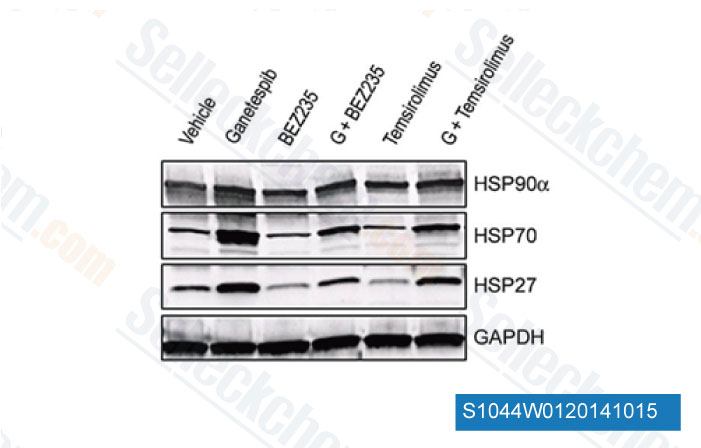
-
Data from [ Mol Cancer Res , 2014 , 12, 703-13 ]
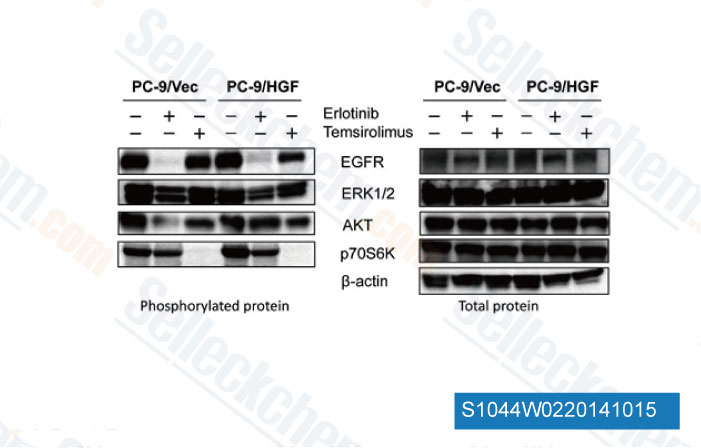
-
Data from [ PLoS One , 2013 , 8, e62104 ]
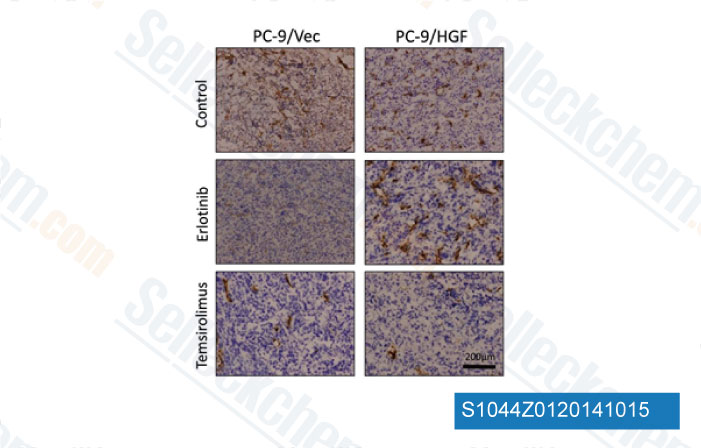
-
Data from [ PLoS One , 2013 , 8, e62104 ]
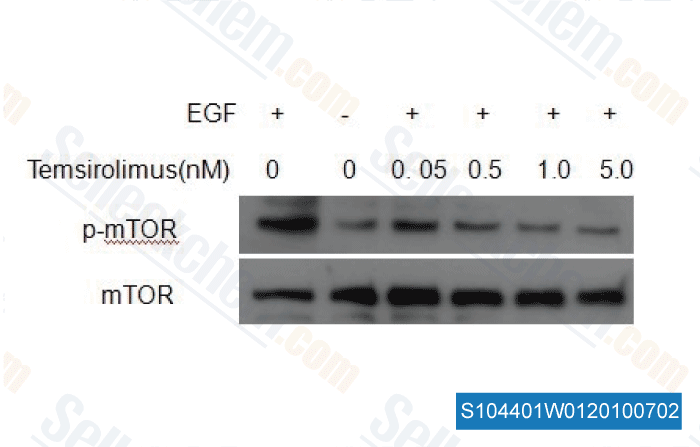
-
, , Dr. Zhang of Tianjin Medical University
Selleck's Temsirolimus (CCI-779) Has Been Cited by 118 Publications
| Therapeutic Efficacy of Temsirolimus in a Patient-derived Model of Metastatic Fibrolamellar Hepatocellular Carcinoma [ In Vivo, September, 1940-1950] | |
| Transformation of quiescent adult oligodendrocyte precursor cells into malignant glioma through a multistep reactivation process [ Proceedings of the National Academy of Sciences, October 7, 2014, E4214-E4223] | PubMed: 25246577 |
| mTOR inhibitors control the growth of EGFR mutant lung cancer even after acquiring resistance by HGF [ PLoS One, May 14 2013, e62104] | PubMed: 23690929 |
| The preclinical assessment of XL388, a mTOR kinase inhibitor, as a promising anti-renal cell carcinoma agent [ Oncotarget, May 02 2017, 30151-30161] | PubMed: 28404914 |
| Stearoyl-CoA desaturase 1 is a novel molecular therapeutic target for clear cell renal cell carcinoma [ Clinical Cancer Research, May 01 2013, 2368-80] | PubMed: 23633458 |
| The novel mTOR inhibitor CCI-779 (temsirolimus) induces antiproliferative effects through inhibition of mTOR in Bel-7402 liver cancer cells [ Cancer Cell International, March 28, 2013, 30] | PubMed: 23537100 |
| The Combination of Trametinib, a MEK Inhibitor, and Temsirolimus, an mTOR Inhibitor, Radiosensitizes Lung Cancer Cells [ Anticancer Research, June 15 2021, 2885-2894] | PubMed: 34083279 |
| Control of the MYC-eIF4E axis plus mTOR inhibitor treatment in small cell lung cancer [ BMC Cancer, April 09 2015, 241] | PubMed: 25884680 |
| SLAP controls mTORC2 integrity via UBE3C-mediated non-degradative mLST8 ubiquitination to suppress colorectal tumorigenesis [ Cell Death Differ, 2026, 33(5):1020-1035] | PubMed: 41398047 |
| Depleting HIF‑1α attenuates the progression of osteosarcoma, but tumorigenicity is sustained through HIF‑independent pathways [ Oncol Rep, 2026, 55(5)94] | PubMed: 41823542 |
RETURN POLICY
Selleck Chemical’s Unconditional Return Policy ensures a smooth online shopping experience for our customers. If you are in any way unsatisfied with your purchase, you may return any item(s) within 7 days of receiving it. In the event of product quality issues, either protocol related or product related problems, you may return any item(s) within 365 days from the original purchase date. Please follow the instructions below when returning products.
SHIPPING AND STORAGE
Selleck products are transported at room temperature. If you receive the product at room temperature, please rest assured, the Selleck Quality Inspection Department has conducted experiments to verify that the normal temperature placement of one month will not affect the biological activity of powder products. After collecting, please store the product according to the requirements described in the datasheet. Most Selleck products are stable under the recommended conditions.
NOT FOR HUMAN, VETERINARY DIAGNOSTIC OR THERAPEUTIC USE.