
|
How to Cite 1. For In-Text Citation (Materials & Methods): 2. For Key Resources Table: |
||
|
Toll Free: (877) 796-6397 -- USA and Canada only -- |
Fax: +1-832-582-8590 Orders: +1-832-582-8158 |
Tech Support: +1-832-582-8158 Ext:3 Please provide your Order Number in the email. We strive to reply to |
Technical Data
| Formula | C24H26N4O4 |
||||||||||
| Molecular Weight | 434.49 | CAS No. | 1012054-59-9 | ||||||||
| Solubility (25°C)* | In vitro | DMSO | 40 mg/mL (92.06 mM) | ||||||||
| Water | Insoluble | ||||||||||
| Ethanol | Insoluble | ||||||||||
| In vivo (Add solvents to the product individually and in order) |
|
||||||||||
|
* <1 mg/ml means slightly soluble or insoluble. * Please note that Selleck tests the solubility of all compounds in-house, and the actual solubility may differ slightly from published values. This is normal and is due to slight batch-to-batch variations. * Room temperature shipping (Stability testing shows this product can be shipped without any cooling measures.) |
|||||||||||
Preparing Stock Solutions
Biological Activity
| Description | CUDC-101 is a potent multi-targeted inhibitor against HDAC, EGFR and HER2 with IC50 of 4.4 nM, 2.4 nM, and 15.7 nM, and this compound inhibits class I/II HDACs, but not class III, Sir-type HDACs. Phase 1. | |||||||||||
|---|---|---|---|---|---|---|---|---|---|---|---|---|
| Targets |
|
|||||||||||
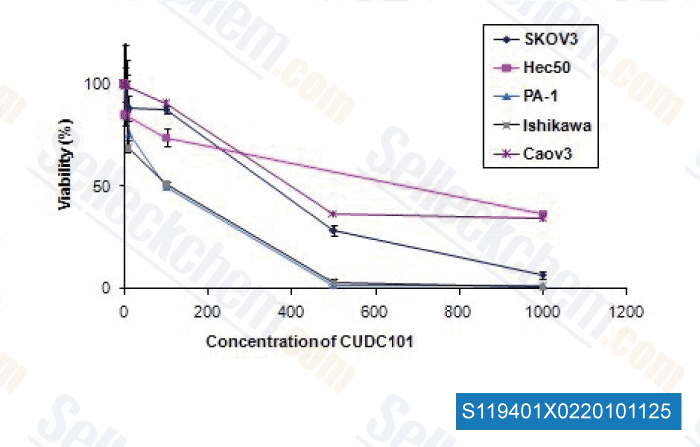
| In vitro | Specific for class I and class II HDACs, CUDC-101 does not inhibit class III Sir-type HDACs. This compound displays weak activity against other protein kinases including KDR/VEGFR2, Lyn, Lck, Abl-1, FGFR-2, Flt-3, and Ret with IC50 of 0.85 μM, 0.84 μM, 5.91 μM, 2.89 μM, 3.43 μM, 1.5 μM, abd 3.2 μM, respectively. It displays broad antiproliferative activity in many human cancer cell types with IC50 of 0.04-0.80 μM, exhibiting a higher potency and combinations of vorinostat in most cases. This chemical potently inhibits cancer cell lines. It inhibits the resistant EGFR mutant T790M although its effects are incomplete with an Amax of ~60% of peak enzyme activity after inhibition. This compound treatment increases the acetylation of histone H3 and H4, as well as the acetylation of non-histone substrates of HDAC such as p53 and α-tubulin, in a dose-dependant manner in various cancer cell lines. It also suppresses HER3 expression, Met amplification, and AKT reactivation in tumor cells. |
|||||||||||
| In vivo | Administration of CUDC-101 at 120 mg/kg/day induces tumor regression in the Hep-G2 liver cancer model, which is more efficacious at its maximum tolerated dose (25 mg/kg/day) and vorinostat at an equimolar concentration dose (72 mg/kg/day). This compound inhibits the growth of -sensitive H358 NSCLC xenografts in a dose-dependent manner. It also shows potent inhibition of tumor growth in the -resistant A549 NSCLC xenograft model. This chemical produces significant tumor regression in the -resistant, HER2-negative, EGFR-overexpressing MDA-MB-468 breast cancer model and the EGFR-overexpressing CAL-27 head and neck squamous cell carcinoma (HNSCC) model. Additionally, it inhibits tumor growth in the K-ras mutant HCT116 colorectal and EGFR/HER2 (neu)-expressing HPAC pancreatic cancer models. |
Protocol (from reference)
| Kinase Assay: |
|
|---|---|
| Cell Assay: |
|
| Animal Study: |
|
References
|
Customer Product Validation
![(a) Decay-corrected microPET/CT scan of MDA-MB-231 tumor bearing mice (n = 4) at 2, 4, and 24 h after i.v. injection of [64Cu]7. The image obtained with coinjection of CUDC-101 (20 mg/kg body weight) is shown for a 24 h blockade. Tumors are indicated by arrows. (b) Decay-corrected region-of interest (ROI) analysis on microPET images of the tumor uptake of [64Cu]7 with or without coinjection of CUDC-101 (20 mg/kg body weight). *, P < 0.05; **, P < 0.01.](https://file.selleckchem.com/downloads/review/700px/CUDC-101-S1194Z0120141211.gif)
-
Data from [ ACS Med Chem Lett , 2013 , 4(9), 858-62 ]

-
, , Dr. Zhang of Tianjin Medical University
-
, , Dr. Xiangbing Meng of University of Iowa
Selleck's CUDC-101 Has Been Cited by 27 Publications
| HDAC6 inhibitor WT161 downregulates growth factor receptors in breast cancer [ Oncotarget, 5 Jul 2017, 80109-80123] | PubMed: 29113288 |
| Novel 64Cu-Labeled CUDC-101 for in Vivo PET Imaging of Histone Deacetylases [ ACS Medicinal Chemistry Letters, 25 Jul 2013, 858-862] | |
| Modulation of Abnormal Vasoconstriction Through 2-Hydroxyisobutyrylation of Tropomyosin 3 Lys141: Targeting Histone Deacetylase 3 as a Key Approach [ J Am Heart Assoc, 2025, 14(1):e037400] | PubMed: 39719422 |
| Histone 4 lysine 5/12 acetylation enables developmental plasticity of Pristionchus mouth form [ Nat Commun, 2023, 14(1):2095] | PubMed: 37055396 |
| CUDC-907, a dual PI3K/histone deacetylase inhibitor, increases meta-iodobenzylguanidine uptake (123/131I-mIBG) in vitro and in vivo: a promising candidate for advancing theranostics in neuroendocrine tumors [ J Transl Med, 2023, 21(1):604] | PubMed: 37679770 |
| CUDC-101 is a potential target inhibitor for the EGFR-overexpression bladder cancer cells [ International Journal of Oncology, 2023, 1791] | PubMed: 37830158 |
| CUDC‑101 is a potential target inhibitor for the EGFR‑overexpression bladder cancer cells [ Int J Oncol, 2023, 10.3892/ijo.2023.5579] | PubMed: 37830158 |
| Non-oncology drug (meticrane) shows anti-cancer ability in synergy with epigenetic inhibitors and appears to be involved passively in targeting cancer cells [ Front Oncol, 2023, 13:1157366] | PubMed: 37274234 |
| High-throughput screen in vitro identifies dasatinib as a candidate for combinatorial treatment with HER2-targeting drugs in breast cancer [ PLoS One, 2023, 18(1):e0280507] | PubMed: 36706086 |
| Development and implementation of the SUM breast cancer cell line functional genomics knowledge base [ NPJ Breast Cancer, 2020, 6:30] | PubMed: 32715085 |
RETURN POLICY
Selleck Chemical’s Unconditional Return Policy ensures a smooth online shopping experience for our customers. If you are in any way unsatisfied with your purchase, you may return any item(s) within 7 days of receiving it. In the event of product quality issues, either protocol related or product related problems, you may return any item(s) within 365 days from the original purchase date. Please follow the instructions below when returning products.
SHIPPING AND STORAGE
Selleck products are transported at room temperature. If you receive the product at room temperature, please rest assured, the Selleck Quality Inspection Department has conducted experiments to verify that the normal temperature placement of one month will not affect the biological activity of powder products. After collecting, please store the product according to the requirements described in the datasheet. Most Selleck products are stable under the recommended conditions.
NOT FOR HUMAN, VETERINARY DIAGNOSTIC OR THERAPEUTIC USE.