
-
 Australia
-
 Austria
-
 Belgium
-
 Brazil
-
 Canada
-
 China
China
-
 Czech Republic
-
 Denmark
-
 Finland
-
 France
-
 Germany
-
 Greece
-
 Hong Kong
-
 Hungary
-
 Iceland
-
 India
India
-
 Ireland
-
 Israel
-
 Italy
Italy
-
 Japan
Japan
-
 Korea
Korea
-
 Luxembourg
-
 Malaysia
-
 Netherlands
-
 New Zealand
-
 Norway
-
 Poland
-
 Qatar
Qatar
-
 Romania
-
 Saudi Arabia
-
 Singapore
-
 Spain
Spain
-
 Sweden
-
 Switzerland
-
 Taiwan
-
 Turkey
-
 United Kingdom
-
 United States
research use only
SSRP1 Antibody [H15L10]
Cat.No.: F6113
Application:
Reactivity:
-
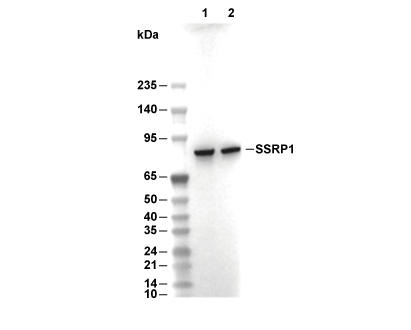 Lane 1: HepG2, Lane 2: Hela
Usage Information
| Dilution |
|---|
|
| Application |
|---|
| WB, IF, FCM |
| Reactivity |
|---|
| Human |
| Source |
|---|
| Mouse Monoclonal Antibody |
| Storage Buffer |
|---|
| PBS, pH 7.2+50% Glycerol+0.05% BSA+0.01% NaN3 |
| Storage (from the date of receipt) |
|---|
| -20°C (avoid freeze-thaw cycles), 2 years |
| Predicted MW Observed MW |
|---|
| 81 kDa 81 kDa |
| *Why do the predicted and actual molecular weights differ? The following reasons may explain differences between the predicted and actual protein molecular weight. Post-translational modifications(e.g., phosphorylation, glycosylation); Splice variants and isoforms; Relative charge; Multimerization. |
Biological Description
| Specificity |
|---|
| SSRP1 Antibody [H15L10] detects endogenous levels of total SSRP1 protein. |
| Clone |
|---|
| H15L10 |
| Synonym(s) |
|---|
| FACT80, SSRP1, FACT complex subunit SSRP1, Structure-specific recognition protein 1, T160, FACT 80 kDa subunit, FACTp80, hSSRP1 |
| Background |
|---|
| Structure‑specific recognition protein 1 (SSRP1) is a nuclear chromatin factor that functions as a histone chaperone within the FACT (Facilitates Chromatin Transcription) complex and as an independent DNA‑ and protein‑binding regulator, coordinating nucleosome reorganization with transcription, replication, and DNA repair. The protein forms an elongated dimeric architecture with distinct N‑terminal and central domains that bind histones and DNA and a C‑terminal HMG‑box–like region that recognizes altered DNA structures, including cisplatin‑modified DNA, providing the structural basis for its dual interaction with nucleosomal components and DNA lesions. As the smaller subunit of FACT, SSRP1 partners with SUPT16H to destabilize and reassemble nucleosomes during RNA polymerase II elongation by transiently promoting release of one H2A–H2B dimer to open chromatin and subsequently supporting restoration of canonical nucleosome structure behind the transcribing polymerase, ensuring efficient transcription through chromatin while preserving overall nucleosome organization. The FACT complex containing SSRP1 participates in DNA replication and DNA damage repair by facilitating progression of replication forks through nucleosomal templates, reorganizing chromatin around repair intermediates, and cooperating with repair factors to maintain genome stability under genotoxic stress. SSRP1 also functions outside the canonical FACT heterodimer as a transcriptional co‑regulator, acting as a coactivator for the p63 transcription factor and associating with casein kinase 2 to promote phosphorylation of p53 at specific residues, linking its chromatin remodeling and DNA‑binding capacity to modulation of p53 and p63 target gene programs that govern cell cycle progression, differentiation, and stress responses. DNA binding via the HMG‑related domain extends to cisplatin‑damaged DNA, and this interaction blocks replication and repair of cisplatin‑modified templates, thereby enhancing cisplatin‑induced cytotoxicity and implicating SSRP1 as a mediator of DNA‑targeting chemotherapy responses. Expression of SSRP1 is elevated in a broad range of malignancies, correlates with proliferative and metastatic behavior, and supports tumor cell survival by sustaining FACT‑dependent transcription of growth‑ and survival‑related genes and by maintaining chromatin plasticity required for oncogenic transcriptional programs. |
| References |
|---|
|
Tech Support
Tel: +1-832-582-8158 Ext:3
If you have any other enquiries, please leave a message.

Products are for research use only. Not for human use. We do not sell to patients.
©Copyright 2013 Selleck Chemicals. All Rights Reserved.