
-
 Australia
-
 Austria
-
 Belgium
-
 Brazil
-
 Canada
-
 China
China
-
 Czech Republic
-
 Denmark
-
 Finland
-
 France
-
 Germany
-
 Greece
-
 Hong Kong
-
 Hungary
-
 Iceland
-
 India
India
-
 Ireland
-
 Israel
-
 Italy
Italy
-
 Japan
Japan
-
 Korea
Korea
-
 Luxembourg
-
 Malaysia
-
 Netherlands
-
 New Zealand
-
 Norway
-
 Poland
-
 Qatar
Qatar
-
 Romania
-
 Saudi Arabia
-
 Singapore
-
 Spain
Spain
-
 Sweden
-
 Switzerland
-
 Taiwan
-
 Turkey
-
 United Kingdom
-
 United States
research use only
Renilla Luciferase Antibody [G15A23]
Cat.No.: F3466
Application:
Reactivity:
-
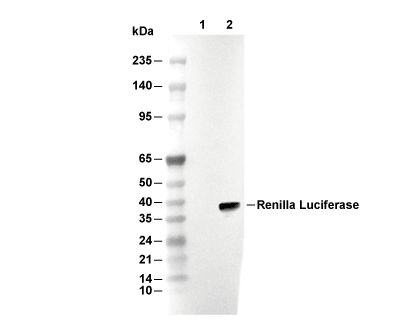 Lane 1: 293T (transfected with an empty vector), Lane 2: 293T (transfected with Renilla Luciferase expression vector)
Usage Information
| Dilution |
|---|
|
| Application |
|---|
| WB, IF, FCM |
| Reactivity |
|---|
| Renilla reniformis |
| Source |
|---|
| Rabbit Monoclonal Antibody |
| Storage Buffer |
|---|
| PBS, pH 7.2+50% Glycerol+0.05% BSA+0.01% NaN3 |
| Storage (from the date of receipt) |
|---|
| -20°C (avoid freeze-thaw cycles), 2 years |
| Predicted MW Observed MW |
|---|
| 36 kDa 36 kDa |
| *Why do the predicted and actual molecular weights differ? The following reasons may explain differences between the predicted and actual protein molecular weight. Post-translational modifications(e.g., phosphorylation, glycosylation); Splice variants and isoforms; Relative charge; Multimerization. |
Biological Description
| Specificity |
|---|
| Renilla Luciferase Antibody [G15A23] detects exogenous levels of total Renilla Luciferase protein. |
| Clone |
|---|
| G15A23 |
| Synonym(s) |
|---|
| Coelenterazine h 2-monooxygenase, Renilla-luciferin 2-monooxygenase, Renilla-type luciferase |
| Background |
|---|
| Renilla luciferase is a coelenterazine-dependent oxidoreductase from the sea pansy Renilla reniformis that catalyzes the oxidative decarboxylation of coelenterazine in the presence of molecular oxygen, generating coelenteramide, carbon dioxide, and an electronically excited product whose relaxation emits blue light and provides a sensitive bioluminescent readout for biochemical and cell-based assays. The enzyme adopts an α/β-hydrolase–like fold that is evolutionarily related to haloalkane dehalogenases, yet its active site has been repurposed as a monooxygenase center containing a catalytic triad in which Asp120, Glu144, and His285, together with additional residues such as Asn53, Trp121, and Pro220, coordinate and position coelenterazine for oxygenation, dioxetanone intermediate formation, and subsequent decarboxylation, demonstrating how subtle modifications of a hydrolase scaffold support a decarboxylating oxygenase reaction. Binding of coelenterazine and O₂ in the active site leads to a short‑lived hydroperoxide and dioxetanone intermediate whose breakdown releases the energy needed to form an excited singlet-state coelenteramide monoanion that emits light with a maximum around 480 nm; in the native organism this energy is transferred via Förster resonance energy transfer to an adjacent green fluorescent protein, shifting the emission to green and amplifying photon output, while in recombinant reporter applications the intrinsic blue emission is typically measured directly. In the Renilla light organ, luciferase functions together with a Ca²⁺‑regulated luciferin‑binding protein that releases coelenterazine upon stimulation and with the Renilla GFP acceptor, forming a tightly organized bioluminescent system with defined kinetics and spectral properties. Cloning of the Renilla luciferase gene and development of optimized variants enable robust heterologous expression without requirement for post‑translational modification, and the enzyme’s strict dependence on coelenterazine and lack of ATP usage make it mechanistically distinct from firefly luciferase, allowing dual‑reporter assays in which Renilla serves as an internal control while firefly reports pathway‑specific transcriptional activity. These properties support extensive use of Renilla luciferase as a quantitative reporter in gene regulation studies, GPCR and kinase pathway assays, RNA interference and CRISPR screens, protein–protein interaction analyses using BRET/FRET formats, and in vivo imaging, where engineered chimeras and red‑shifted variants offer improved brightness and tissue penetration for noninvasive readouts of signaling and gene expression in live animals. |
| References |
|---|
|
Tech Support
Tel: +1-832-582-8158 Ext:3
If you have any other enquiries, please leave a message.

Products are for research use only. Not for human use. We do not sell to patients.
©Copyright 2013 Selleck Chemicals. All Rights Reserved.