
-
 Australia
-
 Austria
-
 Belgium
-
 Brazil
-
 Canada
-
 China
China
-
 Czech Republic
-
 Denmark
-
 Finland
-
 France
-
 Germany
-
 Greece
-
 Hong Kong
-
 Hungary
-
 Iceland
-
 India
India
-
 Ireland
-
 Israel
-
 Italy
Italy
-
 Japan
Japan
-
 Korea
Korea
-
 Luxembourg
-
 Malaysia
-
 Netherlands
-
 New Zealand
-
 Norway
-
 Poland
-
 Qatar
Qatar
-
 Romania
-
 Saudi Arabia
-
 Singapore
-
 Spain
Spain
-
 Sweden
-
 Switzerland
-
 Taiwan
-
 Turkey
-
 United Kingdom
-
 United States
research use only
RAB7B Antibody [K12N3]
Cat.No.: F8526
Application:
Reactivity:
-
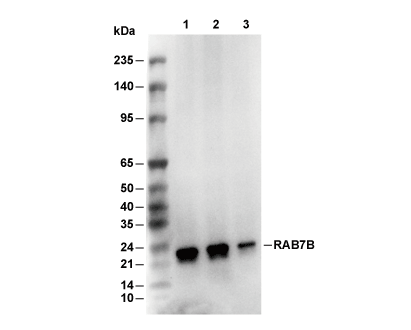 Lane 1: THP-1, Lane 2: 293, Lane 3: U937
Usage Information
| Dilution |
|---|
|
| Application |
|---|
| WB, IHC, FCM |
| Reactivity |
|---|
| Mouse, Human |
| Source |
|---|
| Rabbit Monoclonal Antibody |
| Storage Buffer |
|---|
| PBS, pH 7.2+50% Glycerol+0.05% BSA+0.01% NaN3 |
| Storage (from the date of receipt) |
|---|
| -20°C (avoid freeze-thaw cycles), 2 years |
| Predicted MW Observed MW |
|---|
| 23 kDa 23 kDa |
| *Why do the predicted and actual molecular weights differ? The following reasons may explain differences between the predicted and actual protein molecular weight. Post-translational modifications(e.g., phosphorylation, glycosylation); Splice variants and isoforms; Relative charge; Multimerization. |
Biological Description
| Specificity |
|---|
| RAB7B Antibody [K12N3] detects endogenous levels of total RAB7B protein. |
| Clone |
|---|
| K12N3 |
| Synonym(s) |
|---|
| Ras-related protein Rab-7b, RAB7B |
| Background |
|---|
| Rab7b (Ras‑related protein Rab‑7b) is a small Rab GTPase of the endolysosomal branch of the Rab family that localizes predominantly to late endosomes/lysosomes and the trans‑Golgi network (TGN), where it regulates retrograde membrane trafficking and receptor turnover with particular importance in immune signaling. The protein cycles between a GDP‑bound inactive conformation and a GTP‑bound active conformation through the conserved switch I and switch II regions typical of Rab GTPases, and GTP loading targets Rab7b to LAMP1‑positive late endosomes and lysosomes, whereas a constitutively active GTP‑bound mutant accumulates at the Golgi apparatus, reflecting its role in transport between these compartments. Rab7b controls vesicular trafficking from late endosomes to the TGN and is required for normal lysosomal function: depletion of Rab7b or expression of a dominant‑negative T22N mutant impairs cathepsin D maturation, increases secretion of lysosomal hydrolase hexosaminidase, and alters distribution and trafficking of cation‑independent mannose‑6‑phosphate receptor (CI‑MPR) and TGN46, resulting in elevated levels of late endosomal markers CI‑MPR and cathepsin D while leaving anterograde trafficking of vesicular stomatitis virus G protein unaffected. Rab7b is essential for retrograde transport of cargoes from endosomes to the TGN, including CI‑MPR and mannose‑6‑phosphate–independent sorting receptor sortilin, which both exit the TGN in tubular carriers whose formation and dynamics depend on Rab7b activity, as Rab7b silencing or expression of mutants reduces CI‑MPR/sortilin tubulation and the constitutively active Rab7b Q67L impairs carrier formation from the TGN. In innate immunity, Rab7b functions as a negative regulator of Toll‑like receptor signaling in macrophages by promoting lysosomal degradation of TLR4 and TLR9; Rab7b colocalizes with TLR4 and TLR9 in LAMP1‑positive compartments after lipopolysaccharide or CpG stimulation, decreases TLR protein levels, and thereby down‑modulates TLR4‑ and TLR9‑triggered production of TNF‑α, IL‑6, nitric oxide, and IFN‑β through reduced activation of MAPKs, NF‑κB, and IRF3 pathways. TLR9 ligation down‑regulates Rab7b expression via ERK and p38 activation, and restored Rab7b expression in that context attenuates TLR9‑initiated pro‑inflammatory cytokine and type I interferon production by accelerating TLR9 degradation, positioning Rab7b within a feedback loop that restrains excessive endosomal TLR signaling and limits autoimmune‑type inflammatory responses. |
| References |
|---|
|
Tech Support
Tel: +1-832-582-8158 Ext:3
If you have any other enquiries, please leave a message.

Products are for research use only. Not for human use. We do not sell to patients.
©Copyright 2013 Selleck Chemicals. All Rights Reserved.